

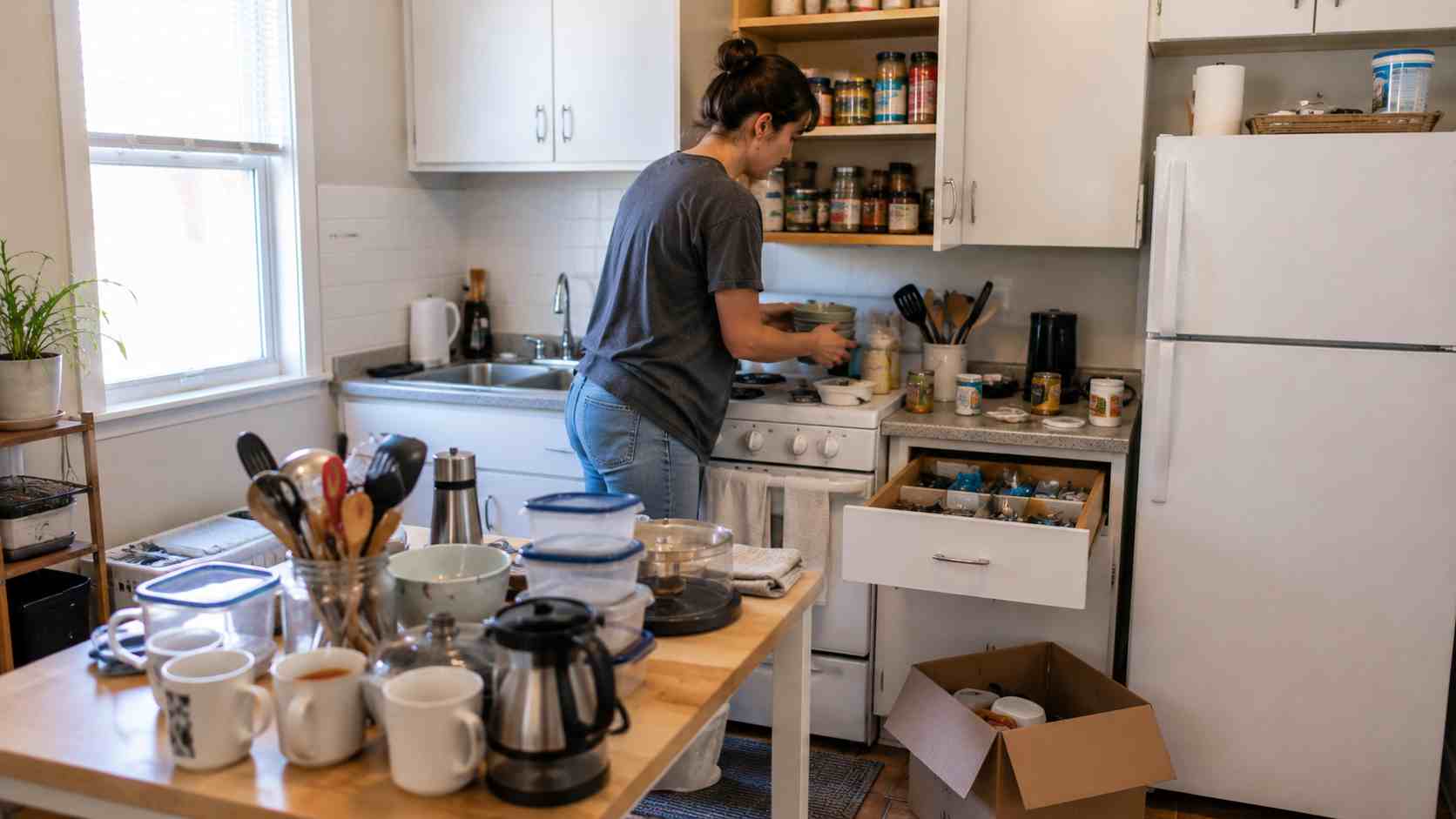

There are a lot more items in the average American home than many realize, and it’s not hard to see why clutter can leave many homeowners feeling overwhelmed. If you reside in an apartment, that quantity seems even heavier. You don’t have as much room to take in all the clutter; every shelf, corner, and closet matters.
One of the best money-spenders you can make for your daily life is learning how to declutter your apartment. Cluttered homes lead to measurable stress hormones (cortisol) rising for the day, while organized homes bring measurable calm, according to research from the Center of Everyday Lives and Families at UCLA.
You’ll discover: How to declutter a small apartment from scratch, a room-by-room action plan, the most effective decluttering frameworks that have been proven by experts, how to arrange your space after decluttering so it remains tidy, and which apartment declutter items to prioritize in case you’re pressed for time.
From apartment renters to downsizers to just wanting to keep things tidy without bumping into anything you don’t want to, it’s the only guide you’ll need!
1. Why Decluttering Your Apartment Actually Matters (With Data)
It’s helpful to know the true price of clutter plus the true benefits of eliminating it before getting started filling boxes.
The Mental Health Link
Researchers from the Journal of Environmental Psychology in 2025 discovered that individuals who perceived their homes as cluttered experienced lower levels of well-being, greater negative emotions, and lower levels of life satisfaction. Women living in disorganized homes had significantly higher levels of the body’s main stress hormone, cortisol, than women living in well-organized homes.
The Princeton Neuroscience Institute found that visual noise literally takes precedence over what you’re thinking about, just like a computer virus takes precedence over a computer. The consequences: decreased concentration, delayed response time, increased mental fatigue.
The money you may be overlooking
Clutter is not only stressful, but it’s also costly! Research conducted by NAPO (National Association of Productivity and Organizing Professionals) has found that the average American replaces items lost in clutter at a cost of approximately $2,000 per year. Moreover, Americans as a whole spend $38 billion per year on self-storage, which is a lot of money for items that they will probably not use again.
Another 23% of adults skip paying bills due to paperwork becoming lost in clutter and creating late fees and possible credit damage.
The Time Drain
The average person loses an average of 12 days every year looking for misplaced items. This is almost an entire work week gone every year, not because of sickness, not because of commuting, but due to disorganization. Decluttering means more than getting space when you are cleaning your apartment. You gain time.
2. The 4 Best Decluttering Methods for Small Apartments
Not everybody’s decluttering system is suitable for those living in an apartment. Here is a comparison of the best four ways (and when to use each).
| Method | Best For | Time Required | Difficulty |
| KonMari (Spark Joy) | Sentimental hoarders, lifestyle resets | 1–3 weekends | High |
| The 90/90 Rule | Practical minimalists, small-space living | 1–4 hours per area | Low |
| Room-by-Room | First-timers, busy schedules | 1 room per session | Medium |
| 4-Box Method | Fast clear-outs, moving prep | 2–6 hours | Low–Medium |
The KonMari Method
Marie Kondo’s approach makes a simple inquiry: Does this bring you joy? You declutter by category (clothing, books, papers, miscellaneous, sentimental) rather than by room. It’s thorough and requires some good time devoted to it, particularly if you’re making a complete lifestyle change or moving.
The 90/90 Rule
The two questions posed by this rule, coined by The Minimalists (Joshua Fields Millburn & Ryan Nicodemus), are: Have you used this item in the last 90 days? Do you plan to use it within the next 90 days? If both are no, it goes. So much so that it has been called by Apartment Therapy the single most popular decluttering technique in the year 2024, and it can be used anywhere, from closets to kitchen cabinets, phone apps to even the fridge.
The Room-by-Room Method
The easiest plan to follow when feeling overwhelmed. One room (or part of one room) is done in one session. The experts say that it’s best to begin in the bathroom (smallest room, less emotional attachment) before tackling more challenging rooms such as bedrooms and living areas.
The 4-Box Method
Label four boxes: Keep, Donate, Trash, Relocate. Walk around each room and put each object in one box. No thinking about it, no hanging it out to dry. It is ideal for apartment decluttering in a pinch, whether you are moving or renewing your lease.
Room-by-Room Guide: How to Declutter and Organize Every Space
This is where the general guidance from the competitors is usually found, such as “begin in the bathroom. This section goes further and provides you with an actual plan of action to follow for each of the rooms in your apartment.
How to Declutter a Small Apartment: The Bathroom (Start Here)
The bathroom is the best place to begin, as there are not many items that are sentimental. Look at expiration dates on medication, sunscreens, and cosmetics (most cosmetics expire in 1 year; foundation expires in 3 months). Throw away items that are similar products that you have purchased and then forgotten. Under the sink, use a tension-rod organizer to double the vertical storage.
- Never flush or dispose of expired medications in the sink or down the drain.
- Double up on toiletries: From the toiletries, keep one and give unopened ones to a local shelter.
- Old towels: clean rags or give away to an animal shelter.

The Kitchen: Your Highest-Clutter Room
The kitchen is the highest-clutter room, and it is time to make it uncluttered.
There are two kinds of kitchen clutter: those things that were bought with good intentions (spiralizer, pasta maker) and those that are actually redundant (four wooden spoons, three can openers). Don’t hesitate to use the 90/90 rule here.
Countertops: Only appliances that are used 3x per week or more get counter real estate. All other items go into a cupboard or are donated.
Pantry: Organize by food group (grains, canned, snacks). Follow a first-in, first-out system (oldest at the front). Discard anything that has been beyond the expiration date or beyond a year without opening.
Utensil drawer: Empty the whole drawer. Only replace items used over the past month. This can recover 40% of the drawer space.
Bedroom: The Emotional Core of Decluttering
The bedroom is the place where the emotional threads are woven together.
The bedroom is the toughest room for most people, as clothes are identifiers and sentimental. The 90/90 rule, plus a second filter: If you didn’t buy this item today at full price, it doesn’t stay.
- Seasonal clothing: keep off-season clothes under the bed in vacuum-sealed bags.
- The “maybe” box: place items in the box, seal and date it. If it has not been opened for 90 days, please donate it even if you don’t open it.
- Nightstand: maximum 3 items. Phone, book, or lamp
Living Room: Declutter Apartment Ideas That Actually Work
Many things don’t have a place anywhere else in the house but in the living room. It’s not about more storage; it’s about less. Each surface should have a single function.
From here on, the “one in, one out” policy will apply: If something new comes into the living room, something goes out. This avoids re-clutter that creeps in after one declutter.
- Coffee table: 1 decorative piece, and remotes in a tray
- Bookshelves: Organize for your 20 favorite books and donate the rest to a library.
- Media and cables: Use zip-tie cords, label plugs, and use a small box to keep remotes together.
Home Office or Work Corner
Here, digital clutter is just as important as physical clutter. An average person gets 121 e-mails a day, and the cognitive load of that is like the load on the average desk of papers. Clean out the computer every 3 months for 30 minutes.
- Papers: scan all important papers (can use apps such as Adobe Scan or CamScanner), recycle originals.
- Desk surface: Only active projects are on the desk; the rest are filed or stored:
- Cables and chargers: Test them this week or throw them out if you don’t know what they charge.
4. Apartment Declutter Items: What to Keep, Donate, or Toss
One of the biggest friction points when you declutter an apartment is decision fatigue. Here’s a clear decision matrix for the most common apartment declutter items.
| Keep | Donate | Toss |
|---|---|---|
| Clothes worn in last 90 days | Clothes in good condition, unused for 1+ year | Worn-out, stained, damaged clothing |
| Appliances used 3x+ weekly | Appliances in working condition, rarely used | Broken appliances collecting dust |
| Books you will re-read | Books in good shape you’ve finished | Old magazines, catalogs, flyers |
| Medications in date | — | Expired medications (pharmacy drop-off) |
| Sentimental items (limited, curated) | Duplicates of sentimental items (photos: scan first) | Broken décor, outdated electronics |
| One set of tools | Extra tools in working order | Rusted, broken, incomplete tool sets |
The Sentimental Item Problem
More than 65% of people admit that the number one problem they have with decluttering is attachment. But the answer is not to be ruthless; it’s to be strategic. Use the camera to take a digital photo of a card or document with a mobile device or a scanning application. This way, you can keep the memory without taking up too much physical space.
If you have physical sentimental items that you wish to preserve, use one box to hold all of your “memory” items. When full, there is no more coming in until there is something going out.
Where to donate items (Efficiently)
- Clothing: Goodwill, Salvation Army, ThredUp (mail-in), or local Buy Nothing groups
- Books: local library, Little Free Library, Better World Books (free shipping)
- Electronics: Best Buy take-back program, local e-waste events
- Furniture: Habitat for Humanity ReStores, Facebook Marketplace, Craigslist free section
How to Keep Your Apartment Clutter-Free Long-Term
One-time decluttering is a satisfying experience. Clutter-free is a system. The research indicates that a new habit takes an average of 66 days to become a habit, which means consistency for two months equals a truly clutter-free lifestyle.
Literally give every item a home. Assign a place to every item.
The one thing that will make your life easier when it comes to clutter is having a designated area for everything you have in your apartment. If there’s no home, it’s clutter. When you say, “on that chair” or “on the counter,” you know that it is not at home yet; make it or let it go.
The 10-Minute Daily Reset
At bedtime, do a quick sweep of the apartment: put things away where they belong, pick up any easy trash, and dust flat surfaces, etc., before going to sleep. This mini-habit is what eliminates the gradual build-up that makes it so overwhelming to declutter in the future.
Pro tip: Put on a podcast or playlist during your 10-minute reset. Making it fun makes it more likely that you’ll do it every day.
The One-Out, One-In Rule
When you add a new shirt to your wardrobe, something old is taken away; when you get a new kitchen gadget, something old is removed; when you read a new book, etc. No exceptions. This one rule, adhered to consistently, will help keep your apartment from getting any messier than it is now.
Quarterly Declutter Audits
Have a mini declutter every three months. Schedule it in your calendar as a dentist appointment. Run through each room that fills up quickest in 30-60 minutes (kitchen, bedroom closet, bathroom) and use the 90/90 rule. Little and often is better than a big once-a-year effort.
FAQ:
What is the time required to clean up a small apartment?
It takes 6-12 hours in a few sessions to declutter a studio or one-bedroom apartment. It’s manageable to do one room at a time (one room per day). A full 2-bedroom may require a weekend of concentrated effort.
What are the best decluttering tips for a small apartment with limited storage?
Make use of overhead storage and shelf risers to make the best use of vertical space. Make the most of multifunctional furniture such as storage ottomans. When it comes to off-season clothes, storage space can be up to 75% less with vacuum-sealed bags. Most of all, have less stuff that continually grows and grows.
What should I do with items I’m unsure about when decluttering my apartment?
Box them, seal the box, write today’s date on it, and put it out of sight. If you haven’t gone looking for anything in that box after 90 days, donate it without opening it. This eliminates second-guessing while preventing regret.
How do I declutter my apartment without feeling guilty about getting rid of things?
Reframe your mindset: donated items go to people who will actively use them. Unused items sitting in your apartment aren’t honoring their original purpose. Digitize sentimental items to preserve memories without physical clutter. Guilt often means attachment, not actual need.
How often should I declutter and organize my apartment?
A 10-minute daily reset prevents accumulation. A 30-minute weekly tidy keeps things maintained. A quarterly audit (90 minutes) catches anything that slipped through. Annual deep declutters are for major resets. The more consistent your daily habits, the less time major sessions require.
What are the best apartment declutter ideas for a rental I can’t modify?
Use freestanding shelving units, over-door organizers, tension rods inside cabinets, and adhesive hooks rated for renters (Command Strips). Focus on decluttering items rather than adding storage. The goal is fewer possessions, not more places to store them.
What’s the 90/90 rule and why is it the best method for small apartments?
The 90/90 rule asks: have you used this item in the past 90 days, and will you use it in the next 90 days? If the answer to both is no, remove it. It works especially well in small apartments because it’s fast, emotionally neutral, and can be applied anywhere in closets, the kitchen, and even your phone storage.
Conclusion
Learning how to declutter your apartment isn’t about becoming a minimalist or purging everything you love. It’s about designing a space where you can actually think, relax, and live without the constant low-level noise of too much stuff competing for your attention.
Here are your three key takeaways:
- Start small and build momentum; the bathroom first, then outward
- Use a proven framework (the 90/90 rule works best for most apartment dwellers)
- Build habits, not just one-time sessions. The 10-minute daily reset is your most powerful long-term tool.
The data is clear: a decluttered apartment reduces cortisol, improves focus, saves money, and reclaims time. All that’s standing between you and that outcome is the first 20-minute session.
Ready to start? Pick one corner of your bathroom right now. Not this weekend. Now. The momentum you build in the next 20 minutes will carry you through the rest of your apartment.