


Each home in the United States has, on average, 300,000 items, and 54% of homeowners feel overwhelmed by clutter, but 78% have no idea where to start.
One of the biggest things you can do that will have the greatest impact on your mental health, finances and quality of life is the decluttering of your home. From busy parents to first-time homeowners to downsizers to homeowners getting ready to sell, this guide has everything you need to know.
In this guide, you will discover what decluttering means and how it benefits you, a step-by-step, room-by-room program for decluttering, practical tips for decluttering quickly, and long-term maintenance of the decluttering results.
What Decluttering Your Home Really Means
Decluttering of Your Home: A Clear Definition
Decluttering is the act of purposefully discarding things that are no longer necessary or desired. Rather than minimalism, it’s about conscious decisions about what deserves its place.
Decluttering vs Organising vs Tidying: Key Differences
Decluttering, organising, and tidying differ in a few ways.
| Action | What It Does | End Result |
| Tidying | Puts displaced items back | Temporary neatness |
| Organising | Creates systems for existing items | Better storage, same amount of stuff |
| Decluttering | Removes what no longer serves you | Less stuff, more space |
| Decluttering + Organising | Removes excess, then organises the rest | Lasting, maintainable order |
Declutter before you organise! Storage bins for a cluttered closet are akin to bailing water without plugging the hole.
When the Art of Decluttering Becomes a Lifestyle
Decluttering your home is as much about what goes in as it is about what goes out. With the excess removed, the question you’ll ask before every purchase is “Does this add value?” When it’s no longer there, you will ask before every purchase, “Does this add value?”
2. The Benefits of Decluttering Your Home
Reducing the clutter in your home offers many benefits. Clearing out clutter can have lots of advantages.
Mental and Physical Health Benefits
The benefits of decluttering your home for health are widely known. The Neuroscience Institute at Princeton University found that you are distracted by visual clutter, which decreases focus and leads to fatigue. Research at the University of Connecticut verified the benefits of decluttering: it lowers stress, boosts mood and confidence, and reduces anxiety.
Those living in messy bedrooms sleep significantly less well. People who live in extremely cluttered houses are 77% more likely to be overweight, in part because they find it more difficult to cook healthy meals when their home is cluttered.
Also, 40% of the housework in the average household is eliminated when it is decluttered.
The Numbers are Striking: Financial Benefits
Some of the benefits of decluttering your home are real dollars and cents: Americans spend $2.7 billion per year replacing things they’ve lost; they lose 2.5 years of their lives looking for things they’ve misplaced; and 11% pay approximately $85/month for storage units that contain items they rarely use. Clutter isn’t just a pain; it’s also costly.
Relationship and Social Benefits
In fact, couples disagree about clutter about three times a month, and family members of cluttered households say they have less life satisfaction. A common, less stressful area is the most effective single intervention for improving relationships.
3. How to Declutter Your Home Step by Step
Step 1: Understand Your “Why”
Write down one specific reason you’re decluttering, not “a cleaner house” but “I want guests to feel welcome” or “I’m selling in 60 days. Keep it visible. It will be of great assistance when decisions get overwhelming.
Step 2: Create Your Decluttering Planner
A home makeover on a weekend is a recipe for burnout. Instead, follow a gradual schedule:
| Household Type | Timeline | Daily Commitment |
| Studio / 1-bed | 2–4 weeks | 20–30 mins/day |
| 2–3 bedroom home | 6–8 weeks | 30–45 mins/day |
| Family home (4+ beds) | 3–4 months | 45–60 mins/day |
| Home for sale | 2–3 weeks | 2–3 hours/day |

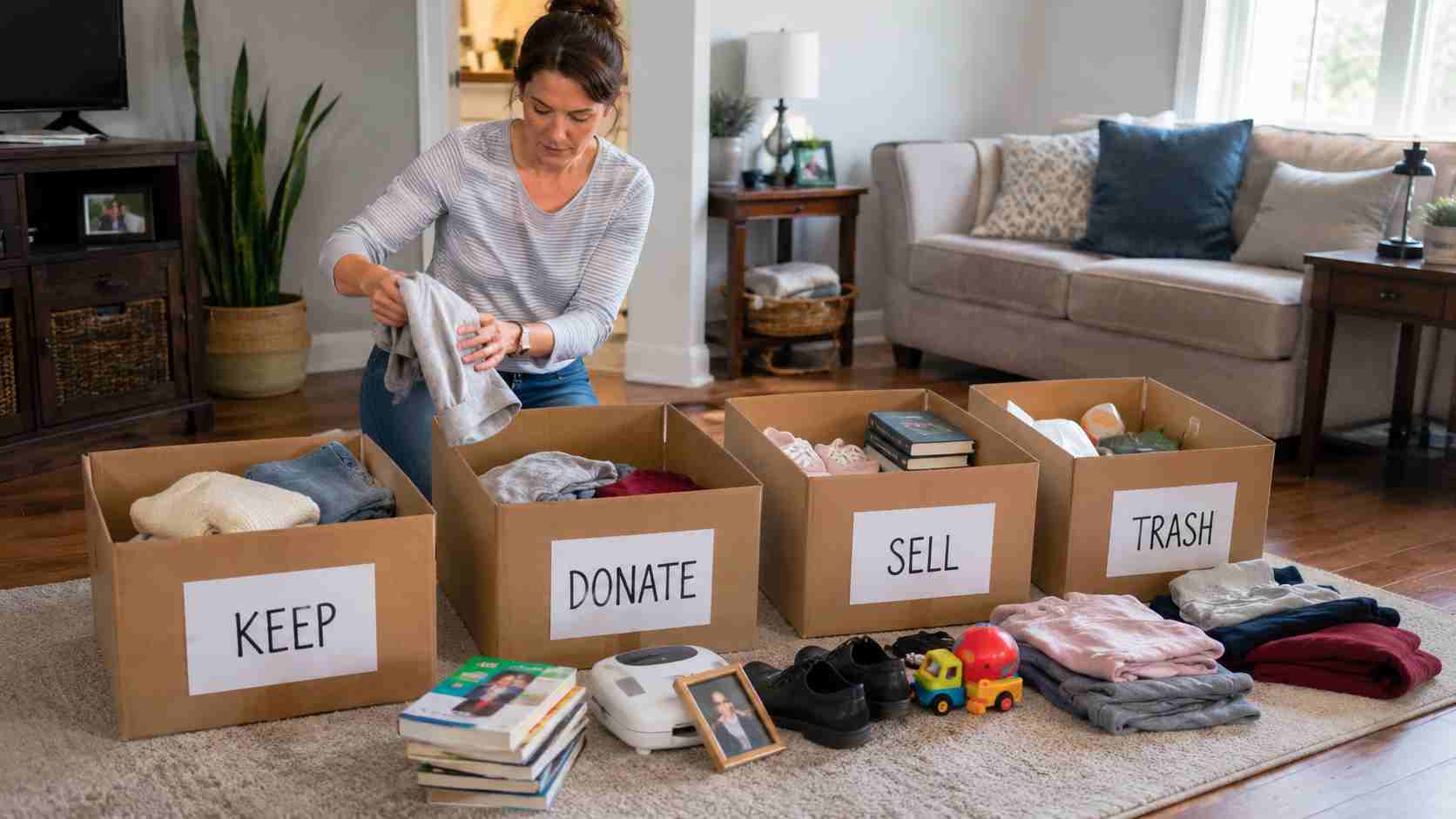
Step 3: Make Four Boxes.
Write on them: Keep, Donate, Sell, Trash. Add a timer. The Pomodoro method (25 minutes on, 5 minutes off) is a great way to get decluttering done.
Step 4: Start Small, Win Early
This is the fourth step in the process. The most crucial decluttering rule: clear the simplest room first! A junk drawer, a bathroom cabinet, the pantry. The early successes help keep you on track, and they help you make tougher decisions when you make them. Never start with sentimental items.
Step 5: Use a Decision Framework
Ask: For each item, ask:
Have I used this in the past 12 months?
Would I purchase this now again?
Do I have a duplicate?
Is this still me or was it me?
Step 6: Quickly and purposefully dispose of items.
Donate: Goodwill, Salvation Army, Buy Nothing groups, women’s shelters
Sell: Facebook Marketplace, eBay, Vinted, Poshmark
Recycle: Best Buy (electronics), H&M bins (clothing), local hazardous waste (paint, chemicals)
Take bags off the day they are taken. Hallway bags are open to interpretation.
Step 7: Organise What Remains
You don’t organize until you’ve got the excess eliminated. Give all items a sensible place. Items that take longer than 5 seconds to put away have no home.
4. Declutter Your Home Room by Room: The Complete Checklist
Kitchen
Any food and condiments that have passed their expiration dates in the pantry.
Use multiple pots and pans, utensils and gadgets.
Appliances that have not been used for 12+ months.
Fractured mugs and containers without lids
Old recipe books, take-away menus and random magnets
Tip: Rotate all mug handles to the right. Anything that remains right after 1 month should be given away.
Living room, Bedroom and Bathroom
Old books, DVDs, CDs you don’t ever want to use again!
Any clothes that are not used for 12 months (face hangers backwards, unworn after one year = gone).
Shoes used less than three times
Outdated medications, cosmetics and skin care products
Extra toiletries purchased due to the lack of originals
Children’s Rooms
Toys that are broken, missing parts, or when the toy is too big for the child.
Artwork (take a photo of it before recycling)
British studies revealed that 10-year-olds have 238 toys on average but only play with 12 a day. Engage children by allowing them to decide what goes to children who need it. This fosters generosity while promoting the habit of decluttering.
Garage, Basement, and Attic
The garage is the most disorganized room in 50% of Americans’ homes. The most-requested fix? Simply removing junk.
Duplicate or replace tools and sports equipment for sports no longer played.
Seasonal items not used for 2+ years.
Boxes of mysterious contents, which have been closed for 3+ years (if you don’t open it after 3 years, you don’t need what is inside).
5. Decluttering Tips for a Quick and Lasting Clean-Out
Three rules will help you to avoid re-cluttering.
One in, one out: One new item comes in, one item goes out. This one simple habit does more to prevent re-cluttering than any organising system.
The 20/20 Rule: If it can be replaced for less than 20 cents in less than 20 minutes, don’t bother. We accept most “just in case” items.
The 12-12-12 Challenge: 12 things to throw away, 12 things to give away, 12 things to put away. Apply this whenever you can’t get up in the morning.
How to Declutter Your Home Quickly
If time is limited, use the speed-round approach: 30 minutes per room, one “quick remove” bag (broken, duplicate, expired only), with no deliberation, and removal of bags the same day. It will not create a deep declutter, but visible progress will keep the momentum going.
Maintenance: The 10-Minute Daily Reset
Take 10 minutes before bed to put things away in their homes. Seasonal review once a quarter. This is practically the only way clutter can’t rebuild because of these two habits.
6. Decluttering Your Home for Sale
Why It’s Non-Negotiable
The buyer buys space and potential. More clutter equals a smaller, less imaginative room. The best preparation for a sale is to get rid of clutter first, and then renovate if needed.
What to Prioritise
Clear kitchen surfaces to 1 or 2 products
Get rid of personal pictures – buyers need to imagine themselves in the house.
Leave wardrobes half full (always open to buyers)
Remove excess furniture to show floor area
Clear the garage to create space to use.
Every room should be functional, clean, and ready for the next guest.
Storage Unit or Permanent Release?
Renting storage is delayed until after selling. Donate, sell, or release for good; use your listing deadline to get rid of that clutter. You don’t want to bring it with you to your next home.
Declutter Your Home Planner: Weekly Template
Mon–Tue: Kitchen (cabinets, pantry, fridge)
Wed: Living room
Fri–Sat: Bedroom (clothing, surfaces, under-bed)
Sat: Bathroom(s)
Sun: Disposal run (donate, sell, trash)
Specificity is everything. The word kitchen is too general; “the three lower cabinets on the left” is actionable.
FAQ:
What is the meaning of decluttering your home?
Decluttering involves intentionally discarding things that no longer have a function or value. Unlike tidying (rearranging) and organising (storing), it decreases the number of items you have (physically and mentally).
What are the greatest advantages of getting rid of clutter?
Less stress, less cortisol, improved sleep, 40% less housework, more focus, and a lot of money saved. There is also evidence that a cluttered home is correlated with poor eating habits and a greater number of relationship arguments.
What do you do when you’re overwhelmed and need to get started decluttering?
Begin in one drawer or one shelf. Set the timer for 20 minutes. Only work in that area. First victories help to gain confidence and momentum for tougher spaces. Avoid starting with sentimental items.
How long does it take to fully declutter a home?
Apartments: 2-6 weeks for 20-30 minutes per day. Family homes: 3–4 months. Decluttering an entire house in one weekend often results in a re-cluttering situation in a few months.
What is the best order to declutter room by room?
Kitchen → bathrooms → living areas → bedrooms → children’s rooms → home office → garage/attic/basement. Leave the sentimental items last, when you’re at your best to make a decision.
Does tidying up boost your mental wellbeing?
Yes. Clutter is known to cause stress and distract from the task at hand, as both Princeton and the University of Connecticut have found. It measurably eases mood, anxiety, sleep, and self-confidence.
How do I declutter quickly before a move or viewing?
Speed round method: 30 minutes per room, quick remove bag only. Prioritise kitchen surfaces, visible storage, personal photographs, highest visual impact for buyers and guests.
What should I do with items I’ve decluttered?
Give to Goodwill, Salvation Army, or Buy Nothing organizations. List it on Facebook Marketplace, eBay, or Vinted. Return the medicine to the pharmacy. Bring electronics to Best Buy electronics recycling. Have it taken away within 24-48 hours.
Conclusion
It’s not about a one-off decluttering; it’s about a lifelong commitment to decluttering your home. It begins with one drawer, one shelf, one 20-minute timer.
Three key takeaways:
There’s more to clutter than space; clutter costs you time, money, sleep, and peace of mind daily.
The system beats willpower: a step-by-step guide, room-by-room checklist, and realistic planner make lasting progress.
The advantages add up: less cleaning, better sleep, clearer thinking, and space for what really counts.
Start today. Not with the attic. Begin with one little victory.
Ready to begin? Take the room-by-room checklist above and schedule your first 20-minute session.