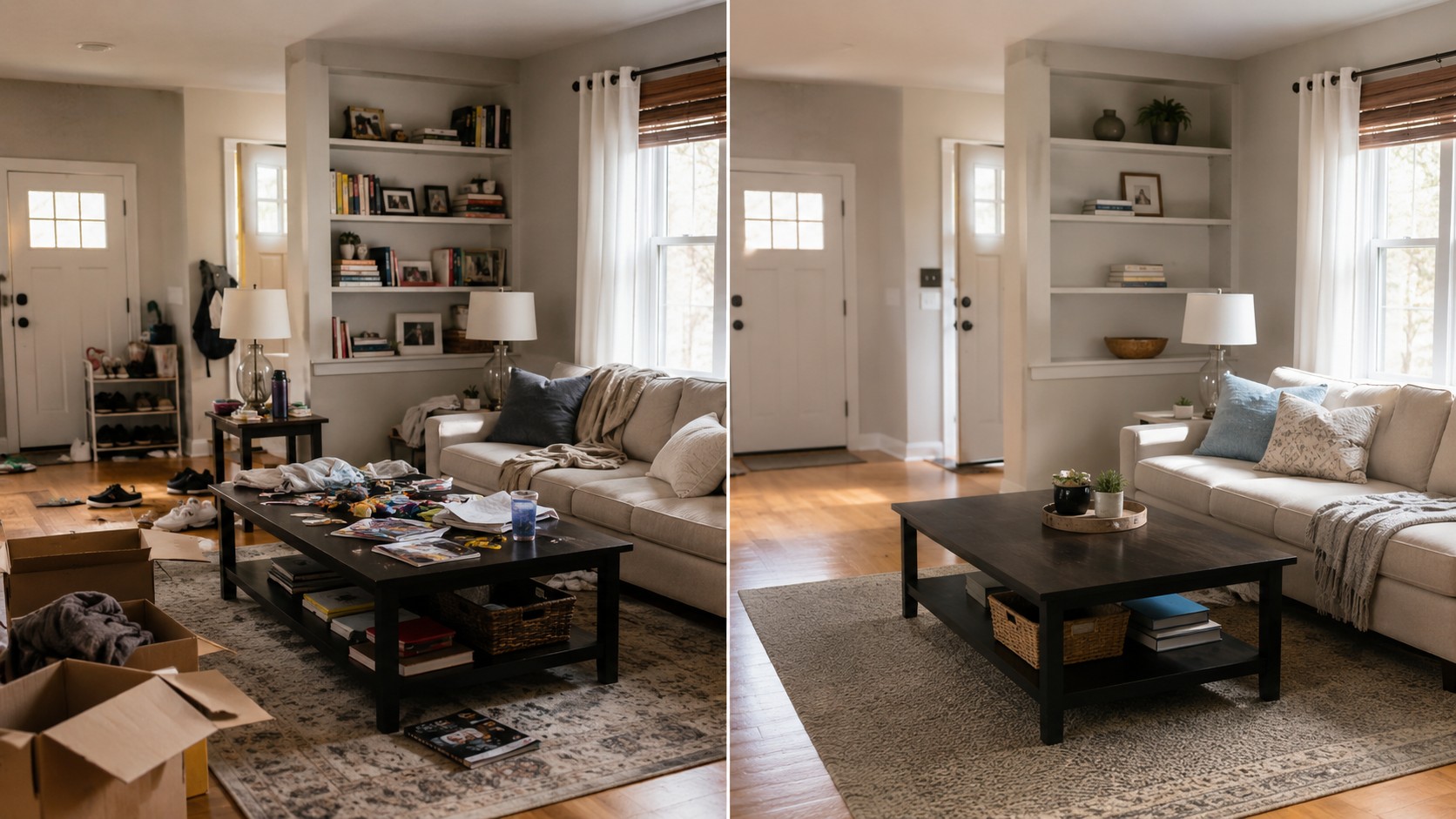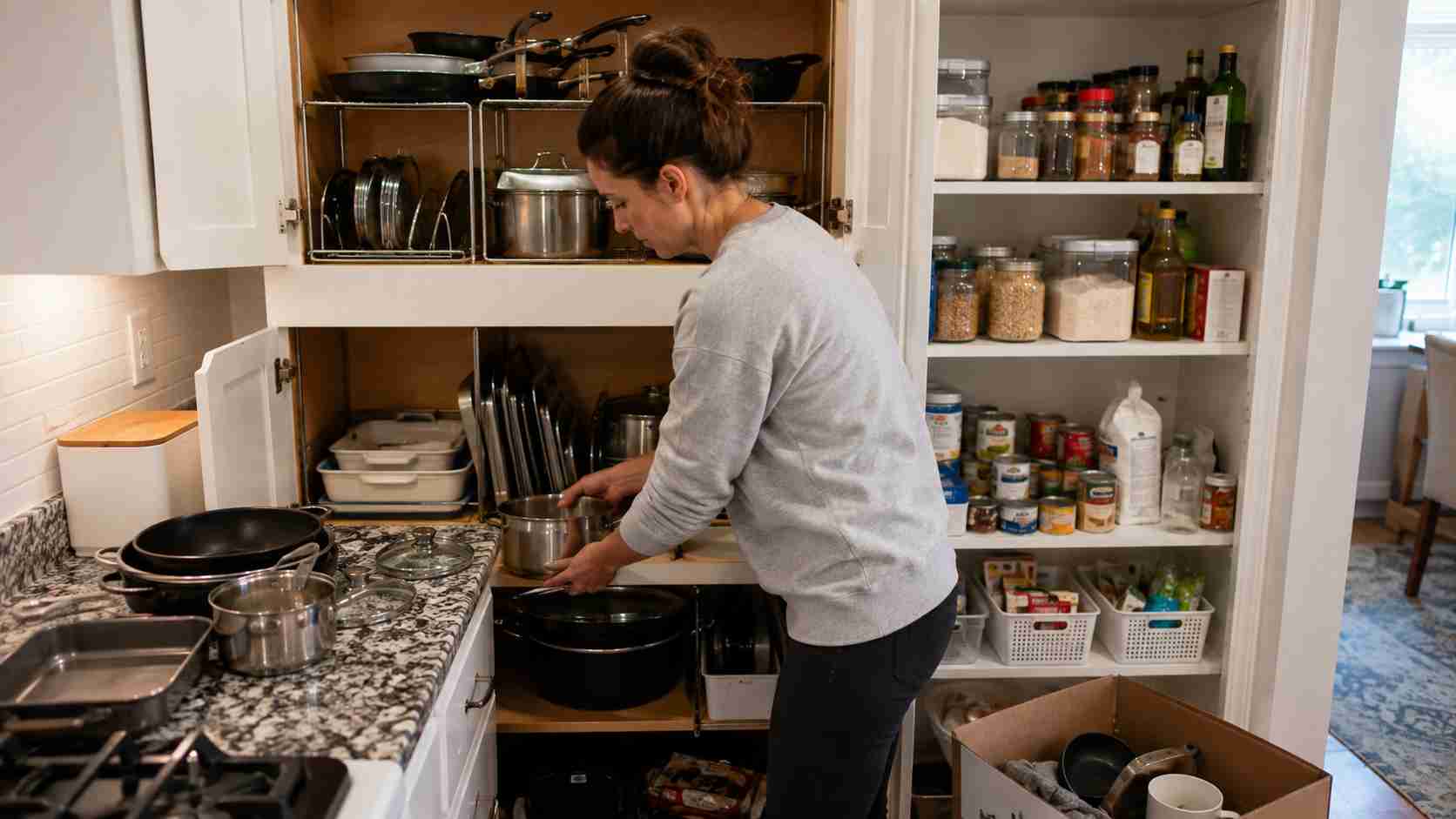
Most of our homes in the U.S. have lots of everyday clutter, and the kitchen is one of the most likely rooms to become cluttered.
Anyone who has ever found themselves standing at the stove looking for a spatula under the 3 mixing bowls and a box of straws that they haven’t touched will be able to relate. The kitchen is one of the most important home projects that can be completed, and it’s one of the least discussed areas. A study revealed that clutter in the home contributes to increased stress levels during the day. It’s an effect that’s repeated every day, at every meal, in your most frequented room: your kitchen.
This Guide will teach you:
- Clean and clutter-free kitchen counter ideas and tips for the long haul.
- Decluttering Kitchen Cabinets and Drawers by Zone: a zone-by-zone system to declutter kitchen cabinets and drawers.
- Which kitchen items and utensils to keep, donate, or throw out!
- Tips for space-saving when cleaning up in a small kitchen or apartment.
- Easy-to-maintain tips for keeping up your results
1. Why Decluttering a Kitchen Changes More Than Just Your Counter Space
People generally believe that the problem of clutter in the kitchen is an aesthetic one. It is really a time, health, and money issue. Researchers have found that a cluttered space decreases the ability of the brain’s visual cortex to communicate messages, and even basic tasks, such as deciding what to cook for dinner, can feel like a challenge. A simple way to organize and declutter your kitchen is to remove items you rarely use and give the essentials a clear place. This can make everyday routines feel much easier.
The Hidden Costs of a Cluttered Kitchen
Here’s what clutter is really costing you:
- Time loss: How much time does the average adult spend looking for lost items in their home? 17 hours a year! Those precious minutes slip away from the kitchen before each meal.
- Stress buildup: Dirty homes are correlated with high cortisol levels all day, not just while you’re standing in the mess!
- Extra spending: You buy duplicates because you can’t find what you already have. Can’t find the cumin? You purchase a second jar. After three jars of cumin, the issue arises.
- Food waste: It is almost impossible to see when to eat items from the unorganized food pantry and fridges before they get too old.
The real benefit of decluttering
Your kitchen is the center of your day: breakfast, dinner preparation, late-night snacking. The whole day is calmer if it is calmer.
Productivity researchers found that decluttering can increase productivity in your home by as much as 77% and reduce stress hormones by 27%. Just one cleared counter can change your mood before even the coffee has cooled.
2. How to Declutter Kitchen Counters (and Keep Them Clear)
The easiest thing to clean up in the kitchen is the countertops. A clear counter makes the kitchen look bigger, cleaner, and more welcoming, even if the kitchen cabinets behind the doors are not fully finished.
Start with a simple counter audit
If you are going to remove anything, please take a picture of your current counter first. This provides a ‘creep’ comparison and will allow you to see if there have been any items that have come onto the counter and not left.
- Appliances are common offenders because they are used less than once a week for some households (bread makers, juicers, air fryers, for some)
- Don’t forget to pack papers, mail, and miscellaneous items. They’re not kitchen items.
- Unused cords that dangle from appliances.
- Duplicate cutting boards, salt and pepper, knives, etc.
The rule that doesn’t get many exceptions: If it is not used for food preparation or daily use, it will not get a permanent counter spot.
Give everything a home
The best declutter kitchen counter ideas work because it provides every item a home. If they don’t have a home, they will simply end up on the nearest flat surface, which is your counter.
- Fit a magnetic knife strip to the wall, which will lift the knife block off the counter.
- Keep coffee pods or paper towels out of the cabinets with an under-cabinet holder.
- Include a small bowl for fruit and nothing else.
- Have one corner as a ‘landing zone’ for keys and small items, and use it every day.
- Organizational research studies have found that a designated spot (not willpower) is the key to keeping spaces tidy.
The surface rule
Once you’ve gone through the initial declutter, try the Surface Rule: If it’s used at least four times a week, keep it on the surface. Evaluate after 30 days. Those that don’t move are moved or donated. It is one habit that makes all the difference between a kitchen that remains organized and one that does not.
3. Decluttering Kitchen Cabinets: A Zone-by-Zone System
Most guides offer general tips such as ‘get rid of everything and organize anew’ when it comes to cleaning up kitchen cabinets. While that’s great for one cabinet, it becomes a big problem in the entire kitchen. The zone-by-zone approach is better and also more sustainable.
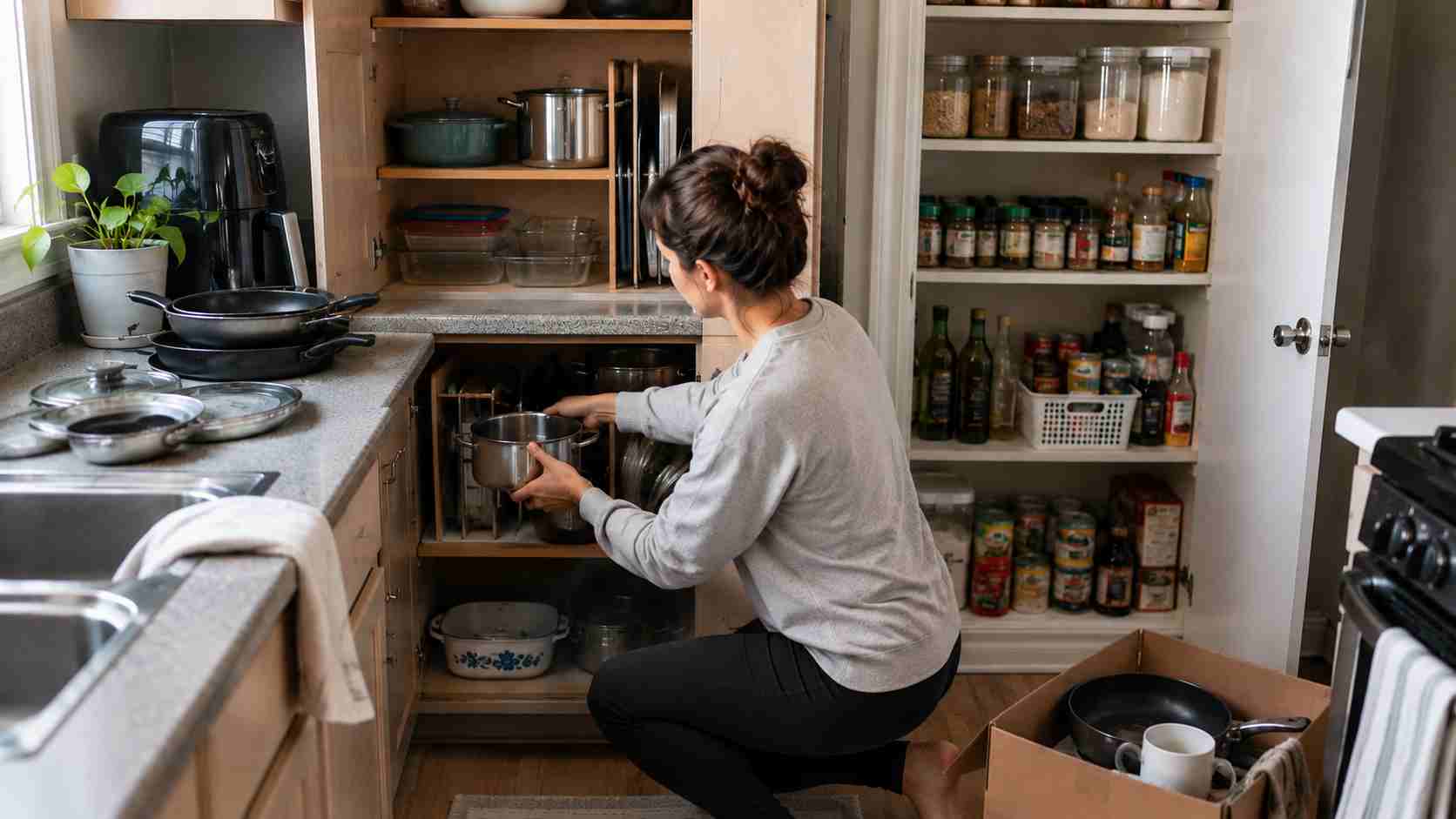
Zone 1: Cooking items
The cooking zone includes pots, pans, and bakeware. Remove just one cooking cabinet at a time. As you take each one out: Have I used this in the past 6 months? If no, and you don’t have a specific time when you’ll use it. It goes.
Keep: 1 – 2 different-sized frying pans, 1 stock pot, 1 saucepan, 1 sheet pan, 1 casserole dish.
Duplicate pans, warped bakeware, lidded pots – toss or donate!
Sort the rest: Put nesting pots by size, hang lids vertically in a small rack or tension rod system hanging inside the cabinet door.
Zone 2: Food storage containers.
Most kitchens have the most consistently cluttered space: their food storage area. The old puzzle: 40 bottoms and 12 lids that match.
Matching test: place all containers with their lids on the ground. Any container without an appropriate, matching, and tight-fitting lid is sent directly. No exceptions. When containers are broken, they are not food-safe, and it’s sentimental to keep them.
Keep: 4 to 6 containers of varying sizes with known matching lids
Donate mismatched sets that are in good condition.
Recycle flattened, discolored, or missing lids; plastics.
Zone 3: Pantry and spices
An approach to decluttering the kitchen items in the pantry is different since you have to consider dates as well as condition. Remove all items from 1 shelf at a time.
- Look for the expiration date on all spices. As you organize your spices, keep in mind that ground spices are generally most effective for 2–3 years, while whole spices can retain their quality for up to 4 years.
- Combine halves of a bag of flour into a full container: duplicates (consolidate)
- Organize by use: Baking; Oils and vinegars; Canned goods by category;
4. Decluttering Kitchen Drawers and Utensils
There’s at least one ‘everything drawer’ in most kitchens, a black hole of rubber bands, dead batteries, mysterious keys, and takeout menus from restaurants that shut their doors in 2018. The kitchen drawers and utensils are one of the quickest wins, as most decisions here are fairly obvious when you actually see what’s in the drawers.
Utensil audit: What you need, not what you think you need.
The first step to decluttering kitchen utensils is to do a reality check. The average kitchen amateur is using fewer than 12 tools in their kitchen every day. All of that backup turned into permanent.
The essential list of utensils that most cooks require:
- One wooden spoon, one spatula (silicone), and one slotted spoon.
- 1 ladle, 1 whisk, 1 pair of tongs
- 1 vegetable peeler, 1 can opener, 1 box grater
- 1 Set of Measuring Spoons and 1 Set of Measuring Cups
Compare with contents of utensil crock. If they are not any better than the ones that you already have, then give them away.
Decluttering Kitchen Drawers: The Empty-and-Sort Method
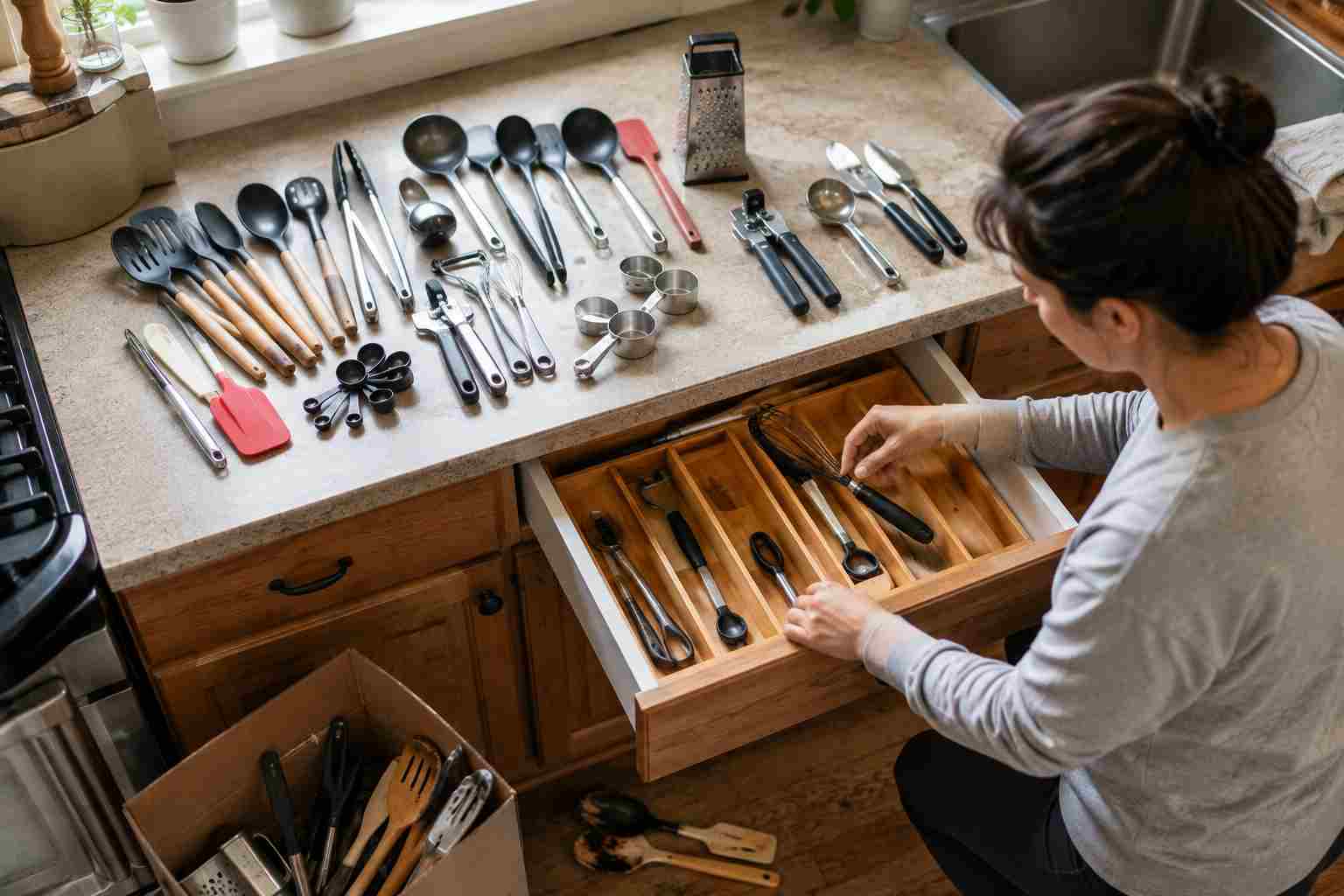
For each drawer, take everything out, wipe inside, and place items in three piles: Keep Here, Keep Elsewhere, Remove. Be tough on the Remove pile. It’s much easier to use a well-organized utensil drawer with 15 utensils than three cramped utensil drawers with 60 utensils.
- Drawer 1 (utensil drawer): Cooking Tools Only (must be in a drawer divider or bamboo tray)
- Drawer 2 (cutlery): knives, forks, and spoons (no other items).
- Drawer 3 (Junk drawer, if needed): set aside one small drawer in it for batteries, one for pens, one for misc. Review it quarterly.
5. Decluttering a Small Kitchen: Space Saving Tips that Work!
Cleaning up a small kitchen isn’t only about reducing the amount of space; it’s about making the most of the space. Even with a well-organized kitchen, the problem is that it can feel cramped when there’s no matching organization system for apartment living, first-time homeowners, or downsizers. Whether you want to declutter your apartment kitchen or organize your space more efficiently, a simple system can make a big difference.
- Use vertical space: When you’re in a small kitchen, it’s the walls and the inside of cabinet doors that are the extensions of your storage capacity. Players don’t really dig into this:
- Install a pegboard over a prep area and hang pots, utensils, and cutting boards.
- Accessible adhesive hooks on the inside of cabinet doors for measuring cups, pot lids,s or foil and wrap boxes
- Mount floating shelves above the counter line to store regular items such as cooking oils, salt, and cookbooks.
- Use the tops of upper cabinets for large, rarely-used items (roasting pans, stand mixer, large serving platters)
- Have multifunctional tools: an immersion blender instead of a full-size blender; a cast iron skillet instead of three specialty graters; a mandoline slicer instead of three specialty graters. Employ a rolling countertop cart to create portable storage when needed.
- Use a donation bin, or bag just inside a cabinet, to collect donations: put things in as you see them that you don’t use, then drop them off each month.
6: Keep vs. Toss – a decision-making system for every kitchen item.
Decision fatigue is one of the primary culprits for kitchen decluttering deadlock. Look at this comparison table and the questions below it and make quicker and clearer decisions.
| Item | Keep If… | Donate If… | Toss If… |
| Pots & Pans | Used regularly, in good shape | Duplicate or extra size | Warped or damaged |
| Containers | Matching lid, fully usable | Extra butin good condition | Cracked or missing lids |
| Spices | Fresh and used often | Recently bought duplicates | Expired or stale |
| Utensils | Functional and used | Duplicate tools | Broken or melted |
| Appliances | Used weekly | Rarely used but working | Broken or outdated |
| Cookbooks | Actually used | Occasional use | Damaged or outdated |
The Three Questions That Cut Through Indecision
Before picking up an object, if you are not sure, ask yourself these 3 questions before putting it back down:
- If I hadn’t been a long-time owner, would I purchase this again today?
- Would I be able to borrow, make do,o or easily replace the same thing for less than $10 in the next 30 days if it wasn’t available?
- Is it a useful addition to my actual cooking routine or to my cooking routine if I ever have one?
If the answer to Question 1 is NO, or the answer to Question 2 is YES, let it go!
7. FAQ: People Also Ask
How long does it take to declutter a kitchen?
A thorough kitchen declutter takes most people 3 to 6 hours for an average-sized kitchen. Breaking it into 45-minute sessions over several days makes it less daunting. A small apartment kitchen can often be completed in a single 2-hour session if you move systematically.
What is the best order for decluttering a kitchen?
Start with counters (immediate visual impact), move to cabinets zone by zone (cooking, storage, pantry), then tackle drawers last. This order means that by the time you reach the drawers, you have already rehomed many items, which makes drawer decisions faster.
How do I declutter kitchen counters without losing functionality?
Keep only daily-use items on the counter: coffee maker, toaster, and knife block if needed. Store everything else. The key insight is that retrieving an item from a cabinet takes under 10 seconds; far less time than working around clutter every single day.
What kitchen items should I throw away first?
Expired spices, mismatched food container lids, duplicate utensils, broken appliances, and anything with damaged non-stick coating. These items have no functional value and are the easiest decisions in any kitchen declutter.
How do I declutter a small kitchen with very little storage?
Prioritize vertical storage: pegboards, inside-door hooks, and floating shelves. Choose multi-function tools over single-purpose gadgets. Reassess every six months.
How do I stop my kitchen from getting cluttered again?
Create a permanent home for every single item you keep, and a weekly 5-minute reset habit. Every Sunday, return stray items to their homes and remove anything that does not belong in the kitchen. Habit, not a one-time effort, is what maintains a decluttered kitchen long-term.
Should I declutter kitchen drawers before or after cabinets?
Declutter cabinets first. Many items currently living in drawers actually belong in cabinets or do not belong in the kitchen at all. Once cabinets are organized, drawer decisions become clearer because you already know which categories of items go where.
Conclusion
Decluttering a kitchen isn’t about perfection. It’s about making daily life easier. You don’t need to have a showroom in your kitchen. It simply needs to be something that suits you every day without using up all of your energy before you’re even in the kitchen. Choose one zone, start the timer for 45 minutes, and go! If you can take one counter off at a time, you will get there.
Ready to start? Save this guide, pass it on to a kitchen reset-hungry friend, and refer to it whenever you’re not certain whether it belongs in your kitchen.