The typical home cook has 20 to 40 spices in their kitchen, but uses just 12 of them regularly. Most of those are tucked away so that they’re hard to locate when a recipe requires smoked paprika at 6 p.m. on a weeknight. The best way to organize spices isn’t only about tidiness; it is about saving time, reducing food spoilage, and even knowing what is in your spice rack before you purchase another cumin jar.
This guide is more than just a collection of beautiful containers. Here you will learn how to categorize spices, how to set up a system for cabinets, drawers, small shelves, lazy Susans, and corner cabinets, how long spices actually last, and how to create a system that will last long after the initial cleaning frenzy.
Find a way for every kitchen, from a large pantry to a 60-square-foot apartment kitchen.
Why Spice Organization Matters More Than You Think
Disorganized spice storage isn’t just an aesthetic problem. It can make meal preparation more difficult, increase unnecessary spending, and lead to food waste. Spice organization is also an important part of kitchen decluttering, as sorting, removing expired spices, and keeping frequently used ones accessible helps create a more functional and organized cooking space.
The Hidden Cost of Spice Clutter
Most people stick with the 5 or 6 spices they can see when spices in a cabinet are mixed up. The Spice and Extract Association estimates that the average American kitchen contains $50 to $150 of unused or expired spices at any given time, based on a survey. It’s a pile of cash sitting in a cabinet and robbing the bank — literally.
How Organization Changes Cooking Behavior
A “visibility principle” in kitchen design is consistently cited as the reason that frequently used items are stored in front of where they can be seen and reached. Spice organization isn’t just for looks; it’s about making it easier to season your meals more often and to avoid ordering takeout due to cooking being too much of a hassle.
Step 1: Audit and Purge Before You Organize
If you don’t do this, then every organizing project will fail faster. The most common mistake people make is purchasing containers before they have an idea of what to keep in them.
Pull Everything Out and Sort
Consolidate all the spices in all the places around the house (cabinets, drawers, spice shelves, junk drawer, and where else?!) onto one counter or table. It is impossible to plan what you can’t see as a whole.
Check Dates and Smell Tests
Ground spices are more likely to lose their flavor than whole spices. If a ground spice doesn’t smell when you open the jar or smells weak and old instead of strong, it’s done. If any whole spices (such as peppercorns or cinnamon sticks) still have a nice aroma when slightly crushed, they will keep for a much longer time.
Consolidate Duplicates
At least three half-used jars of cinnamon will be found at any time. Add them all in one container and toss the remaining ones. This one step can result in the removal of 15-20% of the total spice volume before the construction of any new system.
The Best Way to Organize Spices by Storage Type
The best way to arrange spices in a cabinet, drawer, or shelf is a matter of personal preference and the amount of room available. The following are some tips on how to approach each one.
Best Way to Organize Spices in a Cabinet
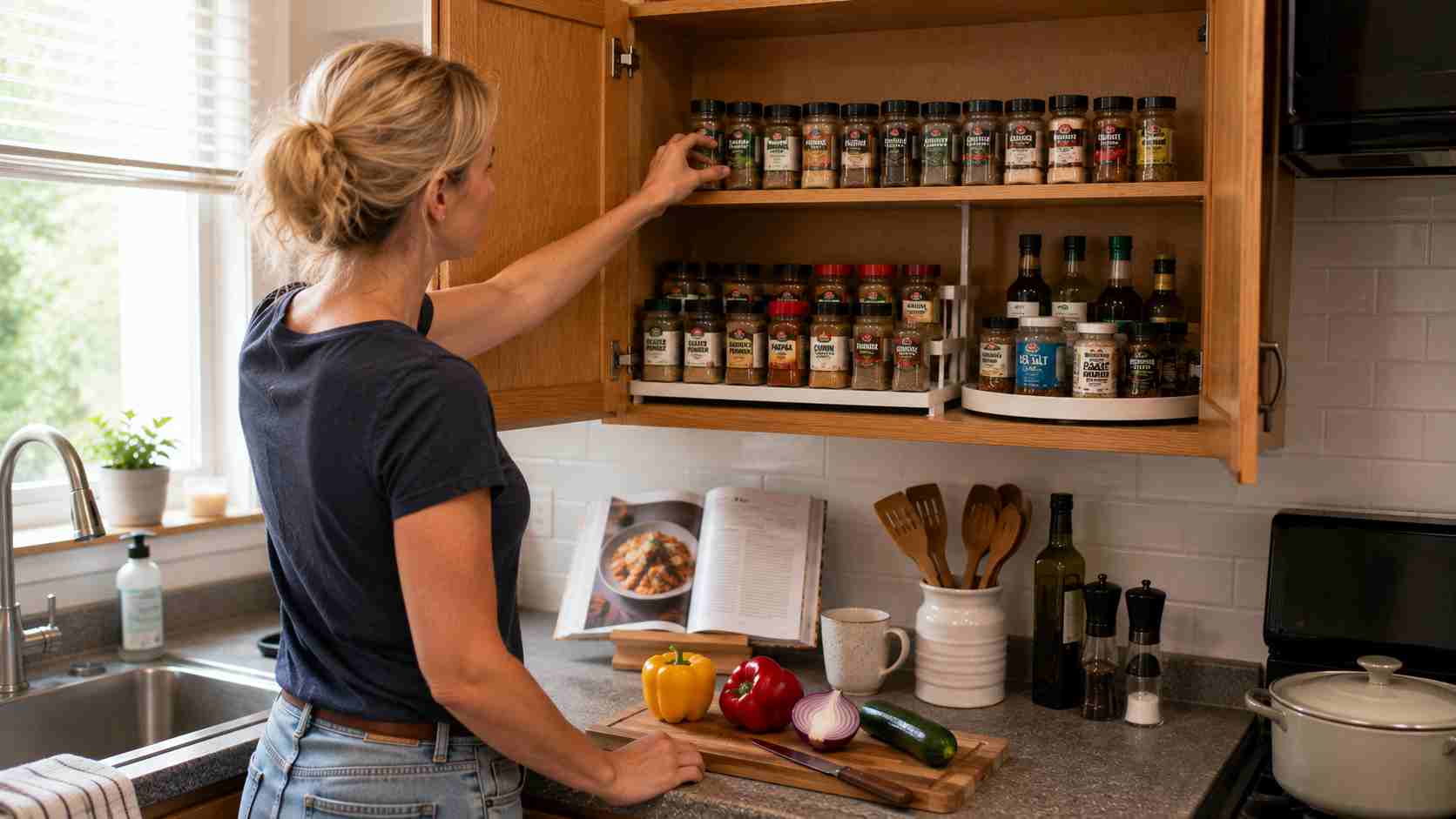
Tiered shelf risers are best for a regular kitchen cabinet. They allow you to view all the labels at once rather than the back row of jars falling out of view. Stack the tall bottles toward the back of the stand and the shorter jars in the front of the stand.
A turntable or lazy Susan also makes excellent use of space within a cabinet, and is discussed in greater detail below.
Best Way to Organize a Spice Drawer
A spice drawer is better for visibility than a cabinet, since everything is flat and you’re looking down on it, as with a filing system. The ideal way to arrange spices in a deep drawer is to use two-tier drawer inserts: a shallow upper shelf for small containers, and a deeper lower shelf for larger containers such as bouillon tins or large salt containers.
Angled inserts that tilt the jars in the direction of the drawer (15-20 degrees) can be used for a standard-depth drawer, allowing labels to be read without lifting anything out.
Best Way to Organize Spices in a Cupboard or Pantry
If you’re using just one shelf in a cupboard or walk-in pantry, then you’re losing valuable space. A spice shelf, stacked or a special wall-mounted spice rack in the pantry door, will convert unused vertical air into usable storage. In a pantry, the spice section might be its own section, away from the canned goods or baking ingredients, and not get “lost” in the rest of the space.
Best Way to Organize Spices in a Lazy Susan
A lazy Susan is definitely one of the most effective gadgets for corner cabinets as well as deep cabinets since you don’t need to look up and down the back of a cabinet you can’t see into. It is best to arrange the spices in a lazy Susan in the zones where you use them most often, with spices, salt, and pepper, garlic powder, and paprika in the front third, less-used spices in the middle third, and special spices in the back third, as the turntable will rotate everything forward in time.
Best way to organize spices, especially in a corner cabinet: a two-tier lazy Susan is the best use of the awkward triangle that shelving just cannot use efficiently.
Comparison: Spice Storage Systems by Space Type
| Storage Type | Best For | Approx. Cost | Visibility Rating | Setup Time |
| Tiered shelf risers | Standard cabinets | $15–$35 | High | 15 min |
| Drawer inserts | Deep or standard drawers | $20–$50 | Very High | 20–30 min |
| Lazy Susan turntable | Corner or deep cabinets | $10–$30 | High | 5 min |
| Wall-mounted rack | Small kitchens, pantry doors | $15–$45 | Medium-High | 30–45 min |
| Magnetic strip | Small shelves, apartments | $20–$40 | Medium | 30–60 min |
| Stackable risers | Pantry shelves | $10–$25 | High | 10 min |
How to Organize Spices by Category
Once your storage tool is chosen, the system you use inside it matters just as much. Most guides in the competition end with “alphabetical or by cuisine,” but there are four different ways, and each one is appropriate to the different types of cooking.
Alphabetical Organization
Ideal for families that have more than one member cooking and require quick access to items without prior knowledge of the other person’s memory. The problem: mixes spices that go well together (such as cumin and coriander) all over the shelf.
By Cuisine or Flavor Profile
Cooks who repeatedly prepare a similar type of dish can use the Italian, Mexican, Indian, or baking spices. It has everything you would need for a particular meal right at your fingertips; that’s a whole lot of time saved on hectic weeknights.
By Frequency of Use
This is the most commonly suggested approach by professional kitchen organizers and is not widely used in the majority of guides. Have the most frequently used spices within easy reach, usually in the top 8-10 spices. All other data is stored in secondary storage. This approach is a direct application of the visibility principle mentioned in the previous section of this guide.
By Category Type
Categorizing spices by type (herbs, ground spices, whole spices, salts, blends) works best for those who prepare a variety of different cuisines and cook based on ingredients instead of food categories. It’s particularly suited for use with drawer systems, where every drawer type may be assigned its own line.
Spice Storage Ideas for Small Spaces
Most spice organization material assumes that you have a lot of room to store spices, which isn’t the case for most people who live in apartments or have small spaces. It is considered the main use case for many renters and first-time homeowners.
Under Cabinet Spice Shelf
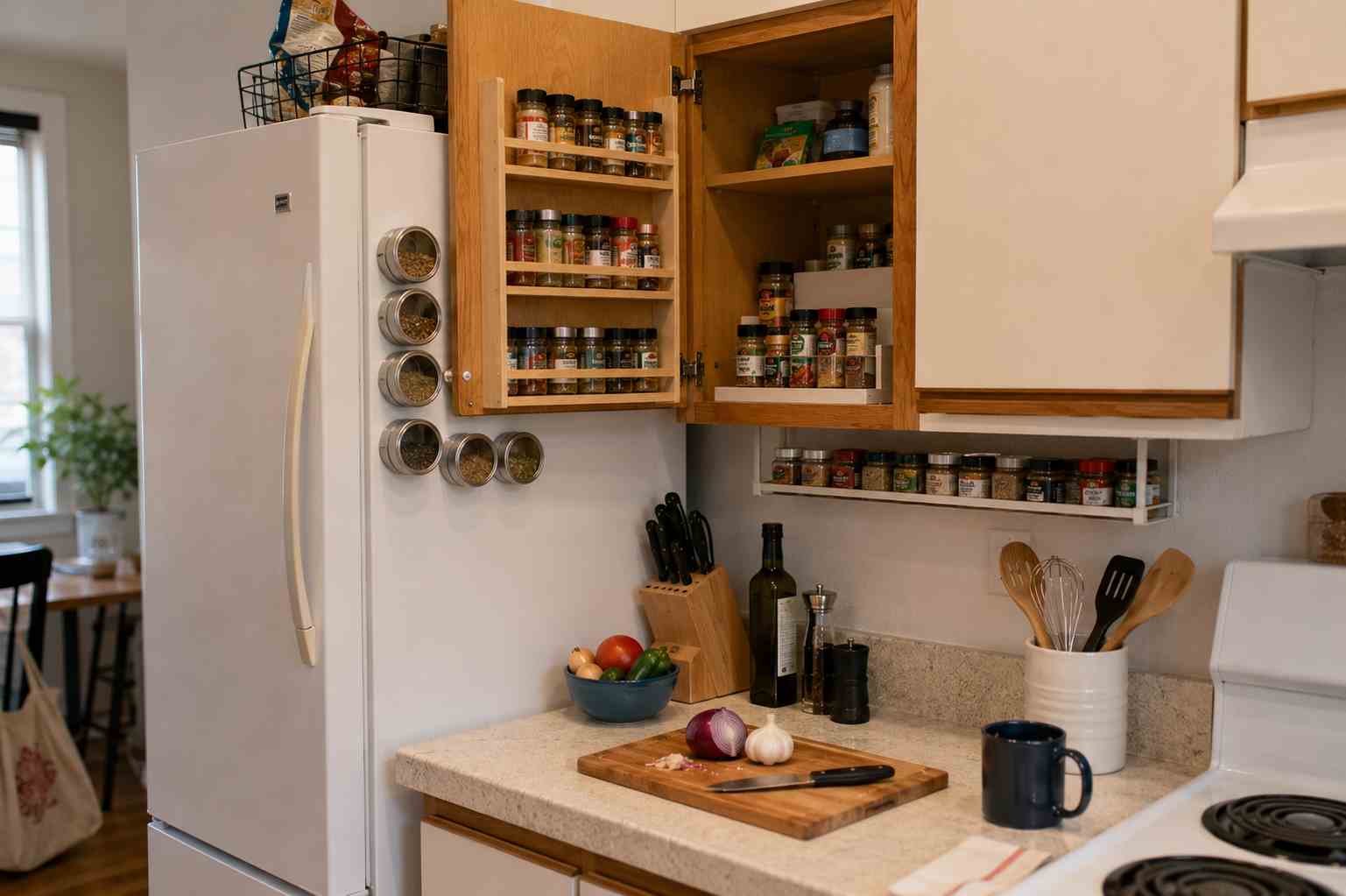
An under-cabinet spice shelf attaches to the bottom of the top cabinets and makes use of dead space that would otherwise be unused. With no drawer or cabinet space required, this is one of the highest-value, lowest-cost solutions to consider, and it costs between $15 and $25.
Door-Mounted Storage
In smaller kitchens, the inside of a pantry or cabinet door is usable space. A 15-20 jar rack or a tension-rod shelf mounted inside the door will only require an inch of space on the shelf.
Magnetic Spice Tins
Magnetic spice tins attach to metal surfaces in the kitchen, such as a range hood, refrigerator side panel, or magnetic backsplash. It’s a low-cost, small-space spice storage project that is also great for galley kitchens where every drawer may be full.
Stair-Step Shelf Inserts
A small shelf insert that forms two or three levels on one shelf in one cabinet can approximately triple the number of jars that are visible at the same time in the same footprint. This is always the most significant and economical addition to a small shelf when it comes to spices.
DIY Spice Organization Projects
There are several projects that can be done at home and will give a similar result to buying a kitchen utensil organizer or spice rack, and they don’t cost anything or much at all.
DIY Drawer Dividers
Cut thin plywood or recycled cardboard to the width of your drawers to make custom rows just the right height for your spice jars. This is more accurate than most of the drawer divider kitchen products that are designed for the average jar sizes instead of your collection.
Repurposed Mason Jar Wall Rack
A wood plank mounted with hose clamps or jar lid brackets makes mason jars a wall-mounted display rack. It’s a perfect choice for kitchens that are small and have limited counter space and cabinets, and it’s an attractive wall solution that can also serve as storage.
Tension Rod Cabinet Shelf
One of the most common annoyances with small cabinets is spice packets falling over or thin bottles falling over, but a nearly free solution is a spring tension curtain rod running horizontally about 2 inches below a shelf in the cabinet to allow the spice packets and thin bottles to stand upright.
Labeling Systems That Actually Last
An attractively organized spice drawer quickly becomes a mess if the labelling system is not up to the demands of the kitchen, steam, and frequent use.
Choosing Pantry Labels That Survive the Kitchen
Paper labels tend to work up quickly in the vicinity of dishwashing and the stovetop. Waterproof pantry label stickers, which are constructed from vinyl or polypropylene, will endure grease, steam, and fading for a far longer time, and most will be able to be removed without leaving adhesive residue should you ever need to switch containers.
Where to Position Labels for Visibility
Labels for pantry containers should be on the top of a drawer system, because this is the only part that is visible when jars are placed flat. If you’re using a cabinet or a shelf system, label the front of the jar, where it will be visible without lifting anything.
Consistent Label Formatting
Label all containers with the same font and label size. Labels that are a combination of handwriting and printed text are disorganized and detract from the visual organization of the cabinet.
How Long Spices Really Last (And How to Store Them Long Term)
The most cursory of the existing guides is the understanding of how to preserve spices and how to store spices for long-term use. The shelf life depends greatly on the type of spice stored and the storage environment.
How Long Should You Keep Spices?
In general, ground spices will keep best for 2 to 3 years, whole spices for 3 to 4 years,s and dried herbs for 1 to 3 years. These are windows of flavor potency, not expiration dates for safety; old spices won’t make anyone sick, but they will diminish the flavor of food.
Best Way to Store Spices Long Term
Light, heat, and humidity are the three enemies of spice potency. A cabinet or drawer is a better place to store spices than a rack placed near the stove, which is a common but ill-advised configuration in many kitchens because it exposes them to heat and light.
Comparison: Spice Shelf Life by Type
| Spice Type | Average Shelf Life | Best Storage Condition |
| Ground spices (cinnamon, paprika) | 2–3 years | Cool, dark, airtight |
| Whole spices (peppercorns, cloves) | 3–4 years | Cool, dark, airtight |
| Dried herbs (basil, oregano) | 1–3 years | Away from heat and light |
| Spice blends | 1–2 years | Airtight, dark cabinet |
| Salt | Indefinite | Any dry location |
| Vanilla extract | 4+ years | Cool, dark cupboard |
Signs It’s Time to Replace a Spice
If the color is visibly faded, the odor is light or none when the jar is opened, or the spice has clumped due to moisture exposure, then it is no longer usable. All of these are flavor issues and directly impact the flavor of your cooking, but none are food safety concerns.
FAQ: People Also Ask
What is the best way to organize spices in a small kitchen?
Use vertical and hidden space first: an under-cabinet spice shelf, door-mounted racks, or magnetic tins. These options add storage without consuming drawer or shelf space, which is the main constraint in small kitchens.
Should I organize spices alphabetically or by category?
Both work well depending on your household. Alphabetical suits multiple cooks who need fast, intuitive access. Category or frequency-of-use suits a single primary cook who already knows their own habits.
How do I organize spices in a deep drawer?
Use two-tier drawer inserts: a shallow tray on top for small jars and a deeper compartment below for bulkier items. This prevents small jars from getting lost at the bottom of an oversized drawer.
What’s the best container for storing spices long term?
Airtight glass jars with tight-sealing lids outperform the original cardboard or plastic packaging spices that come in, since they block moisture and slow flavor loss significantly.
How often should I clean out my spice cabinet?
Once or twice a year is sufficient for most households. A spring and fall check catches expired spices before they pile up and keeps the system from sliding back into clutter.
Is a lazy Susan or drawer insert better for spices?
A lazy Susan is generally better for corner or deep cabinets, while drawer inserts work better when drawer space is already available. Choose based on which storage type your kitchen actually has, not personal preference alone.
Can I reuse old spice jars instead of buying new containers?
Yes, as long as jars are thoroughly washed and completely dry before refilling. Leftover moisture is the most common cause of clumping and early spoilage in reused containers.
What’s the cheapest way to organize spices in a cabinet?
DIY tension rod shelves and repurposed jar racks cost close to nothing and are nearly as effective as store-bought tiered risers for most standard cabinet sizes.
Conclusion
There’s no single best way to organize spices; the right system depends on whether you’re working with a deep drawer, a corner cabinet, a small apartment kitchen, or a full pantry. Three takeaways matter most: purge and audit before buying any organizing tools, match your storage method to your actual cabinet or drawer type rather than copying a system that worked for someone else’s kitchen, and protect long-term freshness by keeping spices away from heat and light.
Start small. Pick one drawer or one shelf, apply the system that fits it best, and label it properly. Once that single space works, the rest of the kitchen follows naturally.