Did you know that the typical American bath has more than 60 personal care products, and we use less than 10 of them regularly? You’re not the only one who finds your bathroom counter to be cluttered and your cabinets to be overflowing. While most bathroom decluttering guides will just get you partway there, cleaning out your bathroom is one of the biggest organizing tasks you can do in the house.
This guide will teach you how to declutter your bathroom counter, cabinets, drawers, and forgotten places. It also includes bathroom cabinet ideas, clever bathroom storage solutions for small bathrooms, and the best systems for your bathroom.
Why Bathroom Clutter Builds Faster Than You Think
The Psychology of Bathroom Accumulation
Bathrooms are particularly susceptible to clutter in three ways. First, the products go through several buying cycles: skin care, hair care, and travel samples, which are bought over the course of several months. Second, there’s an emotional aspect to beauty products: If you have a serum that costs $40, you feel like you’d better use it up or it’s a waste, so you keep using it for as long as you can. Third, hidden storage (under the sink, behind the mirror) is easy for people to close a door and forget what is in it.
The true price of clutter
One study conducted by UCLA Environmental Psychology in 2023 revealed that homes with excessive clutter in personal spaces experienced significantly higher levels of stress in the morning and had longer daily schedules. All those extra seconds spent looking for the right moisturizer or razor each day turn into frustration!
Expired Products pose a hidden health hazard.
Most personal care products have a Period After Opening (PAO) symbol indicating how many months a product will last after opening. Mascara lasts for 3 months, liquid foundation for 6-12 months, and sun cream for 12 months. Expiring products can lead to skin irritation, bacterial infection, and poor UV protection. Cleaning your bathroom is not only a cosmetic thing to do, but it’s also a practice that helps you stay healthy.
Before You Begin: The Decluttering Framework
The Five-Category Method
Skip the basic keep/donate/trash approach. Bathroom items need five categories:
| Category | What Goes Here | Action |
| Keep — Daily Use | Used every day or every other day | Return to prime locations |
| Keep — Occasional Use | Used weekly or monthly | Store in secondary/cabinet storage |
| Expire/Trash | Past PAO date, changed texture or smell | Dispose safely |
| Donate/Give Away | Unopened, unexpired items you won’t use | Shelters, Buy Nothing groups |
| Relocate | Medications, bulk supplies that belong elsewhere | Move to appropriate location |
Audit Before You Empty
Take 10 minutes to take pictures of each storage area before you take anything out. This is a before reference that will help you see your progress and compel you to see the space as a guest. Plan to declutter during a weekend morning that has at least 90 minutes of time to spare. If the bathroom seems too much, divide it into sections and do one section at a time; decision fatigue is a real thing.
How to Declutter Bathroom Cabinets and Under-Sink Storage
Start with a Complete Empty-Out
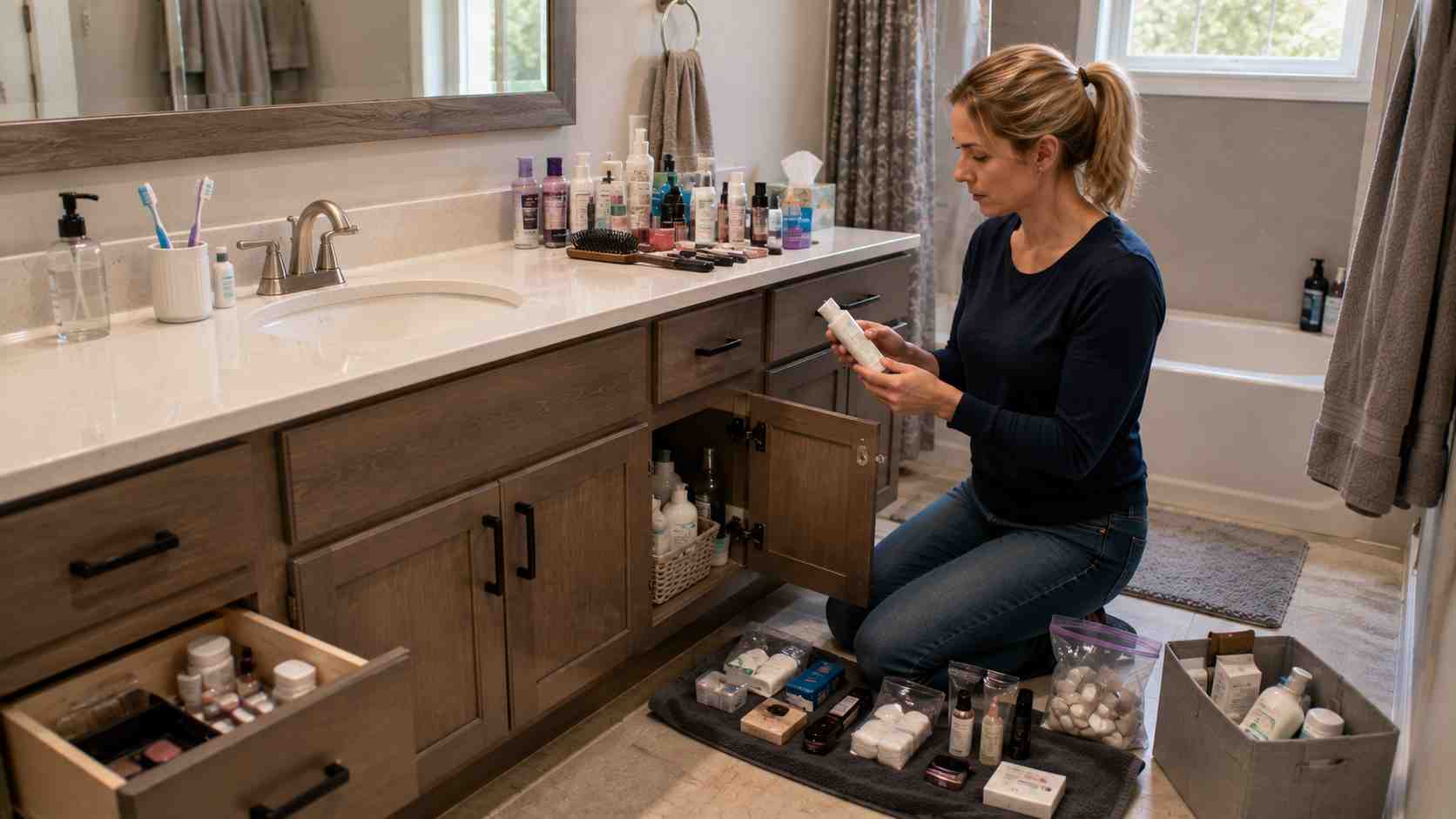
Empty all bathroom cabinets. Duplicates get lost behind one another on the shelves for years when shelving is done by spot checking. Place all items on a clean towel in separate piles: skin care, hair care, medications, first aid, cleaning supplies.
The PAO Check: Your Most Important Filter
Compare all opened products to their PAO symbol. If you don’t remember when you opened it, and the texture, smell, or color is not normal, throw it out. Common lifespans after opening:
| Product | Typical PAO |
| Mascara | 3 months |
| Liquid foundation | 6–12 months |
| Moisturizer/serum | 6–12 months |
| Sunscreen | 12 months |
| Shampoo/conditioner | 12–18 months |
| Body lotion | 12–24 months |
Bathroom Cabinet Organization Ideas After the Purge
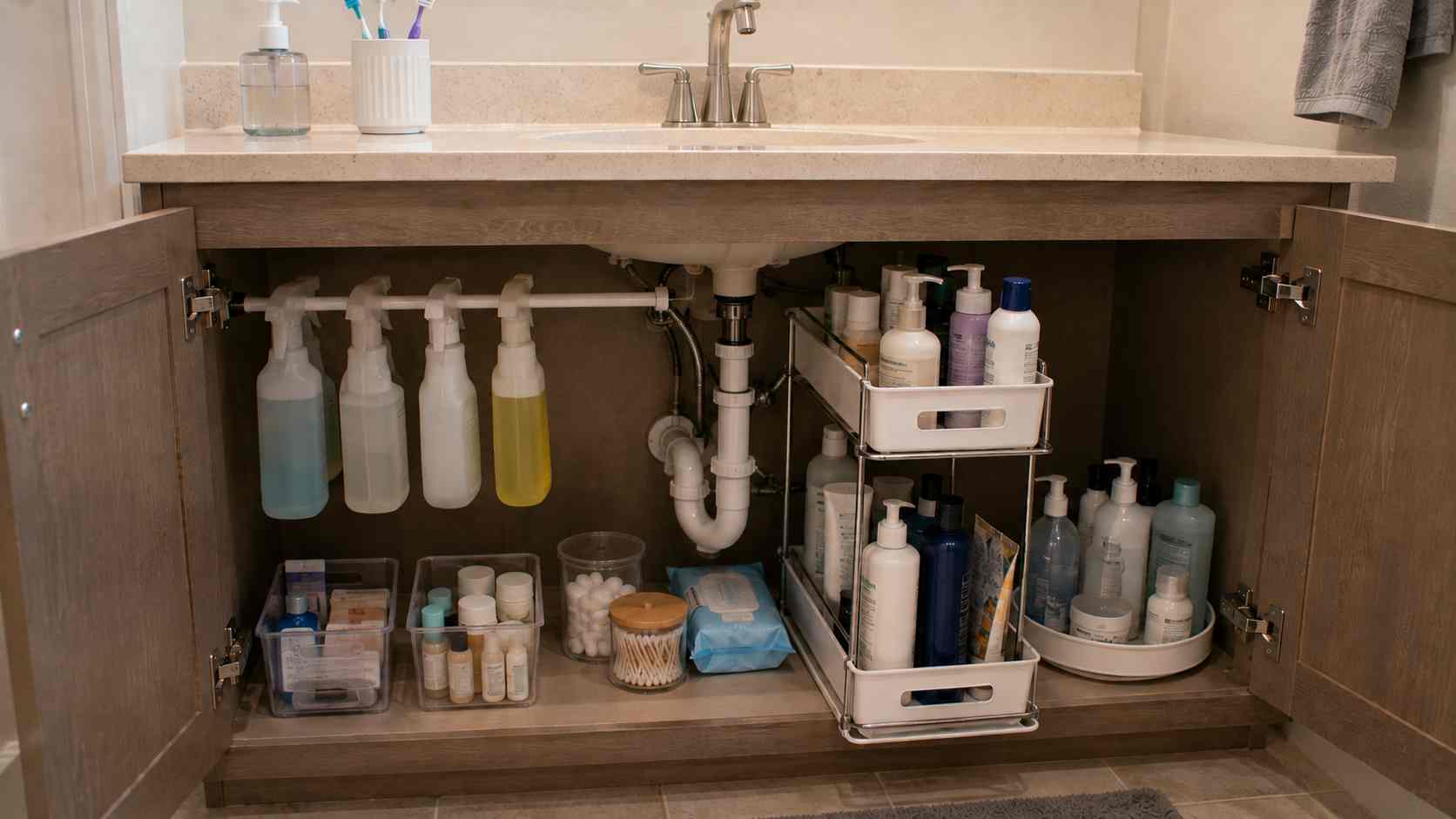
Sort Medications by person, not product, so there is no “digging through someone else’s stuff” issue. A tiered pull-out shelf or lazy Susan is a solution for under-sink cabinets that removes the dead space at the back. Spray bottles hang from their triggers with a tension rod that extends inside the cabinet, freeing up space under the cabinet.
Use one shelf for each bathroom function: towels, backup supplies, cleaning goods, first aid. Labelled bins minimize noise and ease maintenance over time. Keep medicines in a cool, dry cabinet in the kitchen; heat and humidity can harm medicines. Store bulk backup supplies in the linen closet; bathroom real estate is for daily use!
How to Declutter Your Bathroom Counter
The Counter as Prime Real Estate
All the items on your counter are premium rent-free. The best method to declutter the bathroom counter is to first empty the counter and then put back the items you use 5 times a week or more. Items that are usually kept off the counter: cotton rounds (drawer), extra hand lotion (cabinet), hair brushes (when not in use) (drawer or hook), perfume (bedroom shelf, away from humidity).
Declutter Bathroom Counter Without Losing Functionality
It is not a bare surface; it is intentional placement. Most people require just 3 to 5 counter items: hand soap, toothbrush holder, and one daily-use item. Install a soap dispenser and a floating shelf in a small bathroom to make use of the space above the counter. Instead of being used for spice jars, you can use magnetic ones to store cotton rounds or hair ties in the bathroom without needing to drill holes.
Decluttering Bathroom Drawers: A Zone-by-Zone System
Why Bathroom Drawers Become Junk Drawers
Clutter accumulates in the bathroom drawers without anyone realizing it; items fall into the drawers when people come to visit, or when you are in a rush. They collect old products, old batteries, bobby pins, and dozens of forgotten samples over time.
A Three-Step Drawer Organization System
Step 1 — Empty and measure: Take out all the items and measure the interior of the drawer before purchasing any drawer organizers. This 10-inch organiser in the 12-inch drawer starts to become a new clutter area within weeks.
Step 2 — Assign one category cluster per drawer: Hair accessories and tools, dental and skincare, and makeup. Visual noise occurs when categories are mixed.
Step 3 — Use a proper bathroom drawer organizer: These are better than plastic drawer liners every time, and they can be adjusted to fit your items or made into a tray.
Use the 1 in, 1 out approach: For every new item put into the drawer, an old item should be taken out. If this were not in place, a well-organized drawer would turn to chaos within 2 to 3 months.
Decluttering Bathroom Forgotten Spots Most People Miss
The Back of the Door
The bathroom door is used by most homes for one of two purposes, or not at all. Clear pockets in an over-the-door organizer contain hair tools, skin care, first-aid, or guest toiletries completely out of view when the door is opened. Zero renovation required.
Inside Cabinet Doors and the Shower
Hair ties, tweezers, and nail files are attached to cabinet interiors with adhesive hooks. Bobby pins and small tools are stored in a magnetic strip. People have 3 or 4 half-full bottles of the same product in the shower. Mix them, throw out the empty containers, and commit to finishing one before opening the second. Change loofahs every 3-4 weeks as they become contaminated with bacteria.
The Space Above the Toilet
The area in the bathroom that is least used. Here, an over-the-toilet shelf or floating wall shelf offers a full additional storage space for backup toilet paper, extra towels, or a small plant, with no need to reach for the counter or floor.
Decluttering Bathroom Tips for Small Spaces
Go Vertical
In a small bathroom, there’s only so much floor and counter space, so small bathroom with closet ideas can help make better use of the walls. Floating shelves, ladder shelves, stacked towel bars, and hooks at different levels provide storage without taking up floor space. Even the 18 inches of wall space between the toilet tank and ceiling, which is often left clear, can hold a shelf for extra storage.
Compact Organization Systems That Actually Work
| Storage System | Best For | Cost Range |
| Over-the-door organizer | Toiletries, tools, first aid | $15–$40 |
| Tension rod under sink | Spray bottles | $5–$12 |
| Tiered lazy Susan | Cabinet dead zones | $15–$30 |
| Floating shelf above toilet | Backup supplies | $20–$60 |
| Stackable clear bins | Bathroom closet organization | $10–$25/set |
| Drawer dividers | Makeup, dental, accessories | $15–$35 |
Shared Small Bathrooms
Set aside specific areas (if possible, small areas) for each person. Clear containers are matched under the sink per person to avoid the “where did my thing go” issue. A portable caddy per child that can be moved with the family from the bathroom to the restroom, eliminating product drift on all surfaces, is ideal for families.
FAQ: People Also Ask
How do I start decluttering my bathroom when I don’t know where to begin?
Use up old products (most objective, least decision-making). Use a timer and make sure to check dates on PAOs throughout all cabinets and drawers for 20 minutes. Throwing out expired items is usually sufficient to eliminate 30-40% of the bathroom clutter without making any hard decisions.
How often should I declutter my bathroom?
Declutter twice a year (spring and fall). The lighter the monthly pass (clearing empties, checking expiries, resetting the counter), the less chance the space has of getting into the overwhelming stage between full sessions.
What bathroom items do people most often forget to declutter?
The back of the door, inside cabinet door panels, shower floor corners, the area above the toilet, and expired first aid kits. These forgotten bathroom spots are the places that get cluttered and are not noticed because they are out of view.
What should I never store in a bathroom?
Medications (which break down in heat and humidity), fine jewelry (which tarnishes in humidity), important documents, and bulk backup supplies. Toiletries should be stored in a linen closet and not the bathroom cabinet!
How do I keep my bathroom organized after decluttering?
Three habits: (1) One in, one out policy for new products; (2) 5-minute counter reset at the end of each week; (3) monthly inspection of empties and out-of-date products. The systems that allow easy retrieval of items are the ones that last.
What is the fastest way to declutter a bathroom before guests arrive?
Clear the counter first: Move all items into a caddy or bin under the counter. Clean visible surfaces, fold and put away towels, and check for soap and toilet paper. Even when there are still things to do in the bathroom, the overall organization is enhanced by a clear counter and clean surfaces.
Conclusion
The first step in decluttering is organizing. There is no bathroom storage solution, drawer organizer, or innovative bathroom storage concept that can solve a space that just has too much.
Three key takeaways:
Check with the PAO: out-of-date products are the simplest to remove and can be impacting health.
Use the zero-base counter approach: take everything away and bring back only what is worth it.
Make use of under-used areas: There are plenty of unoccupied spaces in your home that you don’t use, such as the back of the door, inside cabinet doors, and above the toilet.
Begin this week with one zone. One of the most compact rooms to remodel and one of the most impactful changes you can make in your day-to-day is a well-organized bathroom.
Start with one zone today. A calm, organized bathroom is one of the smallest spaces to transform and one of the highest-return changes you can make to your daily life.