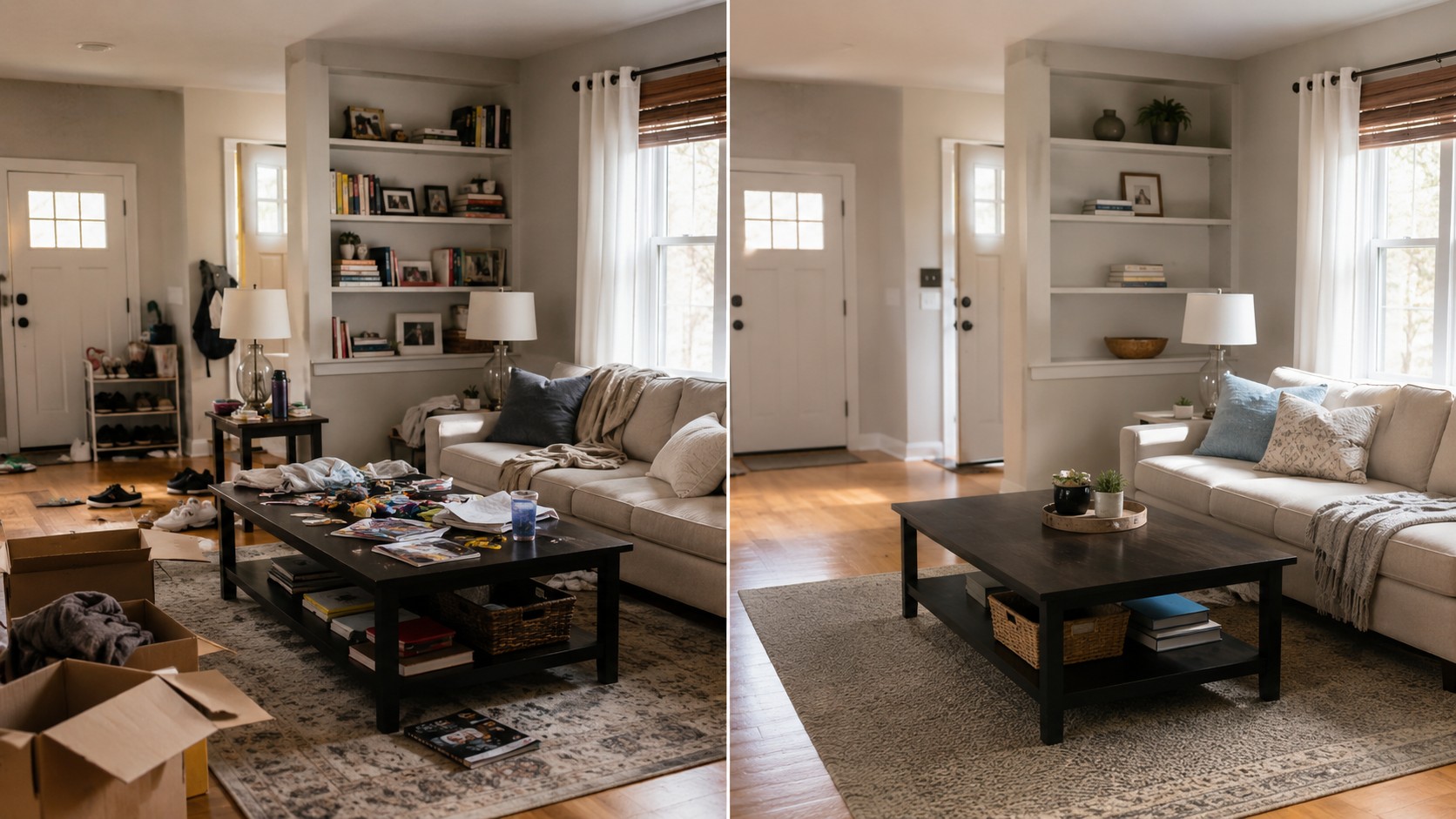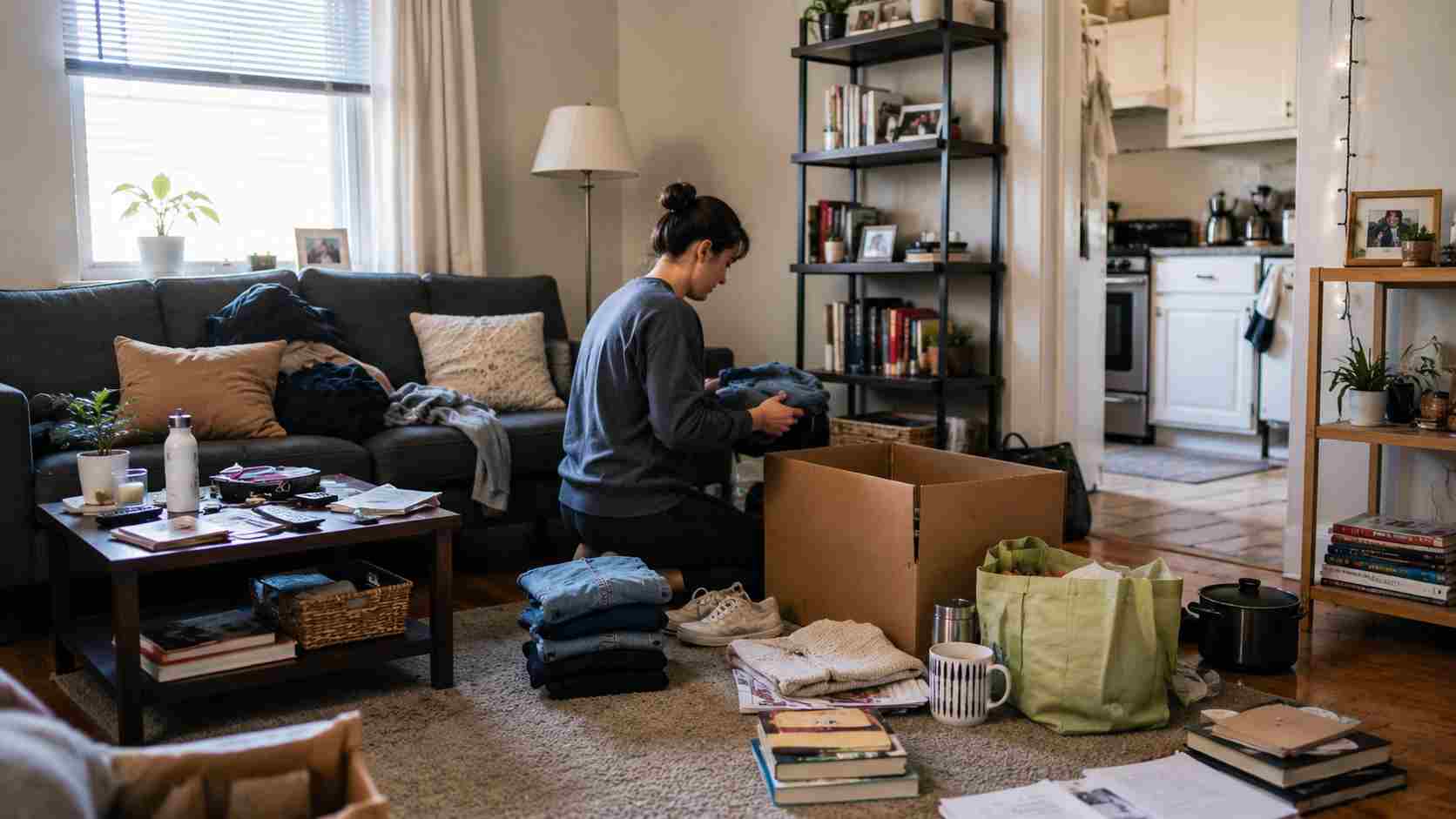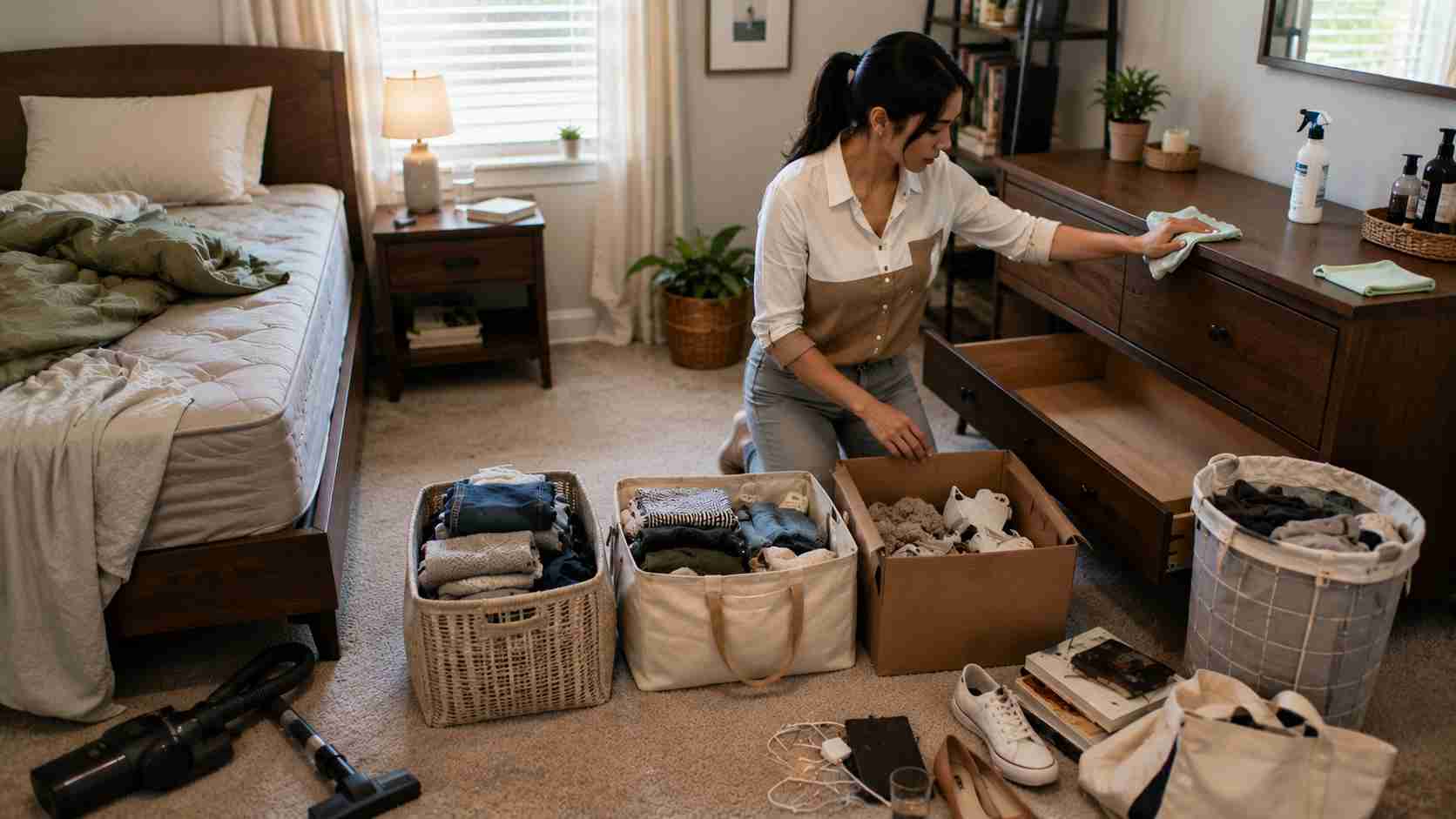
Did you know that the average person spends approximately 26 years of their life sleeping, but most people never clean their bedrooms to the extent that they should? An unorganized, dusty bedroom is more than just an eyesore. UCLA researchers found that when you’re physically cluttered, you’re cognitively cluttered, too, and that physical clutter makes you more stressed and actively affects the quality of sleep. If you’ve ever thought about the proper way to clean your bedroom, or how to clean a really messy bedroom without losing your mind, you’ve come to the right place.
Here you’ll discover how to clean a bedroom quickly when time is precious, how to do a deep clean of a bedroom step-by-step, how to create a clean bedroom checklist for children and adults, and how to keep a clean room and stop the chaos from returning. From clean bedroom minimalist decor to cozy bedroom ideas, whatever you’re looking for, this guide is for you!
How to Clean a Really Messy Bedroom
Most people try to clean their entire bedroom all at once and end up getting tired before they finish, which is the largest reason why a messy bedroom remains messy. The fix is to deliberately start a sequence to build momentum.
Step 1: Declutter Before You Clean
Before you start cleaning, declutter your bedroom by clearing away anything that’s out of place. Cleaning around clutter won’t solve the problem.
Take three bags or boxes, and label them Keep, Donate, and Trash. Pick up the pieces of your room one by one, going from the door to the right. This means that you won’t be able to re-walk the same areas. UCLA’s Center on Everyday Lives of Families reported that cluttered home environments increase cortisol (the stress hormone), particularly in women. Decluttering is not simply tidying up; it’s a mood intervention.
If your bedroom is super cluttered, the quickest way is to start with the surfaces: tidy all the horizontal surfaces (floor, dresser, nightstand, desk) first, then the interior of rooms such as closets and drawers. This will help you see your progress right away and will keep you motivated.
Step 2: Trash First, Always
Clear all garbage receptacles and pick up visible trash such as wrappers, cups, receipts, and packaging. It takes less than five minutes to complete but instantly makes the room 20% smaller. If there’s no bin in your bedroom, put one in. There is an open-top laundry basket by the door that collects dirty clothes and various junk.
Step 3: Sort Your Clothes
Most households have the number one source of clutter in their bedrooms: dirty clothes. Collect all items on the floor, on chairs, or hanging off the footboard. Put them into the hamper, fold/hang immediately, or bag for donation. The “chair pile” is a universal problem; choose a little hook on the back of your door to hang tomorrow’s outfit on.
Step 4: Work Top to Bottom, Always
When it comes to cleaning your bedroom, gravity is your friend. Begin with the ceiling fan, then light fixtures, then shelves, dresser tops, then nightstands, and wait until the floors. The result is that dust that is knocked off while dusting high surfaces will fall to the floor and be collected by the vacuum cleaner in the last pass. This is a tip that every competitor guide fails to include.
Deep Clean Bedroom Checklist
A bedroom cleaning checklist is a unique type of bedroom cleaning session. It will target the surfaces, zones, and items that you would typically miss, and preferably, you should do it every 3-6 months. This is the most comprehensive deep-clean bedroom checklist around, broken up into zones.
Bedding and Mattress Zone
Wash all bedding. Remove all bedding: sheets, pillowcases, duvet cover, comforter, mattress protector, and decorative pillow covers. The American Academy of Allergy, Asthma & Immunology says that dust mites can be in a mattress and recommends washing sheets in hot water (at least 130°F/54°C) once a week. Don’t just wash the sheets; wash the pillow inserts themselves every 3–6 months.
Wash the mattress in your bedroom. One thing that is usually overlooked is the clean bedroom mattress process for sleep hygiene, but it is extremely important. Here is the complete procedure:
- Vacuum the top, sides, and underside (if possible) with the upholstery attachment.
- Spot treat stains with a 1:2 mixture of dish soap and cold water. Use a 50/50 hydrogen peroxide and cold water solution for protein-based stains (sweat and blood) – blot, don’t scrub.
- Spread a big layer of baking soda over the surface of the mattress and leave it on for at least 2-4 hours or overnight. Baking soda sucks up oils, moisture, and odors.
- Thoroughly vacuum up the baking soda.
- For a soothing and refreshing fragrance, add some lavender essential oil to the baking soda prior to using.
Rotate your mattress. Turn it upside down 180 degrees head to foot each quarter. If double-sided, also flip it. This helps to spread the wear evenly and can extend the mattress’s lifespan by several years.
Furniture and Surfaces Zone
Systematically clean bedroom furniture. Clear out all the drawers and clean the inside with a slightly moist microfiber cloth. There’s more dust in drawers than many people realise, particularly in the back corners: clean drawer faces, handles, and the tops and sides of all pieces. To prevent drying, apply a wood conditioner or lemon oil to wood furniture.
Headboard and bed frame. Cleaning approach depends on material:
| Material | Cleaning Method | Product to Use |
| Solid wood | Wipe with a damp cloth, then dry immediately | Mild dish soap + water, then wood oil |
| Metal frame | Vacuum + scrub with soapy water | Dish soap + water; rust remover if needed |
| Upholstered | Vacuum first, then blot stains | Mild upholstery cleaner |
| Leather | Vacuum, then wipe gently | 50/50 white vinegar + distilled water |
| Rattan/wicker | Vacuum with brush nozzle | Warm soapy water, air dry fully |
Nightstands. These are magnets for clutter! Clear out all the contents, and if there is a shelf or drawer, clean it, then reconsider what should be on it. Empty out everything, clean the top, and if there is a drawer or shelf, clean it as well, and then think about what should be in it. Try to get no more than three: a lamp, a water glass, and one book.
Walls, Windows, and Air Zone
Most deep cleaning instructions end with furniture and floors. This is where this guide comes in handy.
Walls and baseboards. Use a Melamine eraser (Magic Eraser) to clean up scuffs. Vacuum baseboards first with a brush attachment and then wipe with warm soapy water. Baseboards trap an incredible amount of dust and pet hair; without them, all the other cleaning is for nothing.
Curtains and blinds. Unhook and shake out curtains before washing on a cool cycle in the washing machine. Vacuum all fabric blinds. Wooden or faux-wood blinds can be cleaned by wiping each slat with a slightly damp cloth. The simplest trick for Venetian metal blinds is to put old cotton gloves in soapy water and rub each slat.
Windows and mirrors. Fill a spray bottle with 10 parts water to 1 part white vinegar. Use for glass surfaces and apply with vertical strokes on glass using a microfiber cloth. Wash the mirror frames and window sills one at a time.
Ceiling fans and air vents. Disconnect vent covers before turning off HVAC. Clean covers with soap and water, rinse covers thoroughly, and put them back in place. When cleaning ceiling fans, place an old sheet over the bed first, then use a pillowcase to cover each fan blade, and pull it back to gather up the dust without spreading it.
Clean Bedroom Floor: Carpet vs. Hard Floors
The last obstacle is a clean floor in your bedroom. Lastly, clean the floors.
Carpet: Vacuum in overlapping passes, against the grain of the pile to lift embedded debris. Rotate furniture, put it on its side to vacuum underneath, particularly under the bed. To deep clean, use a carpet shampooer (which can be rented from most home improvement centers) every 6–12 months. Shampoo the carpet and then clean the baseboards.
Hardwood/Laminate: Sweep or dry-mop first, then use a slightly wet mop with a pH-neutral cleaner. The hardwoods should not be treated with vinegar because it will deteriorate the finish over time. Apple cider vinegar is just right for vinyl plank: one cup per gallon of warm water. Dry the floor after mopping; otherwise, it will warp.
How to Clean a Bedroom Fast
Sometimes you can’t have a long session. These cleaning bedroom hacks will help you clean a bedroom quickly (20 minutes or less) and effectively.
The 4-Zone Speed Method
Split your bedroom into four areas: bed, floor, surfaces, and storage. Work for 5 minutes on each. It avoids the danger of getting caught up in one thing (the closest rabbit hole is well known!) and neglecting the others.
Cleaning Bedroom Hacks That Actually Work
The “outbox” trick. Have a little basket at the door that is called the “Outbox. Anything that doesn’t belong in the bedroom goes in there. Empty it when you leave the room (not before). That prevents you from getting out of the room in the middle of cleaning to store it away; that always slows things down.
The top-sheet method. Fold up the comforter above unmade beds. The visual cleanliness of the room will be about 70% due to a made bed. Use this to your advantage: People think a room that has a neat bed is a lot cleaner than it really is.
The spray-and-walk-away approach. Spray surfaces with all-purpose cleaner and then clean other surfaces during the time the all-purpose cleaner is applying. After 2 minutes, return to wipe. The dwell time does the rest.
Vacuum in one pass. Perform the vacuum sweep around the room with an attachment-free vacuum in one pass, and then in one pass across the center of the room in one direction. An average bedroom will take less than three minutes.
How to clean a bedroom fast when guests are coming: Make the bed, tidy the floor and the table of the bedside table, close open drawers, and light a candle or use a room spray. Make sure that the closet door closes. Completed in less than 15 minutes.
Clean Bedroom Decor and Storage Ideas
A bedroom that’s easy to keep clean is one designed with storage in mind. When it comes to bedroom decor, good clean decor isn’t just about looking nice and clean; it’s about being functional and minimizing the work that goes into tidying up.
Clean Minimalist Bedroom Principles
The three rules for a clean minimalist bedroom are: Every item has a place, Surfaces remain as clear as possible, and Storage out of sight. A 2015 study in the journal Sleep also reported that symptoms of sleep disorders were significantly lessened in those who tidied their sleeping areas and made the bed every day.
For clean bedroom decor ideas that feel calm and intentional:
- Consider a neutral base palette of white, warm grey, and soft linen, and add texture instead of pattern for interest.
- Do not create too many pieces of art.
- Replace open shelves with bedside tables with drawers.
- A corral on the dresser is used to organize things; it makes it more organized and less cluttered.
Clean Cozy Bedroom Ideas
A clean cozy bedroom doesn’t mean sterile. The idea is to be warm but not cluttered. Here are some cozy bedroom ideas that will work for a clean look.
Make thoughtful use of textiles: a fitted sheet, a duvet, two to four pillows (not twelve). This leads to more of a laundry burden than this.
- Install warm-colored lights, such as 2700K bulbs, in bedside lamps.
- Throw in one blanket folded up at the foot of the bed; it looks purposeful and not cluttered.
- A small plant, like a snake plant, pothos, or peace lily (all of which have been proven to purify the air), brings life without adding clutter.
Bedroom Storage Solutions That Prevent Clutter
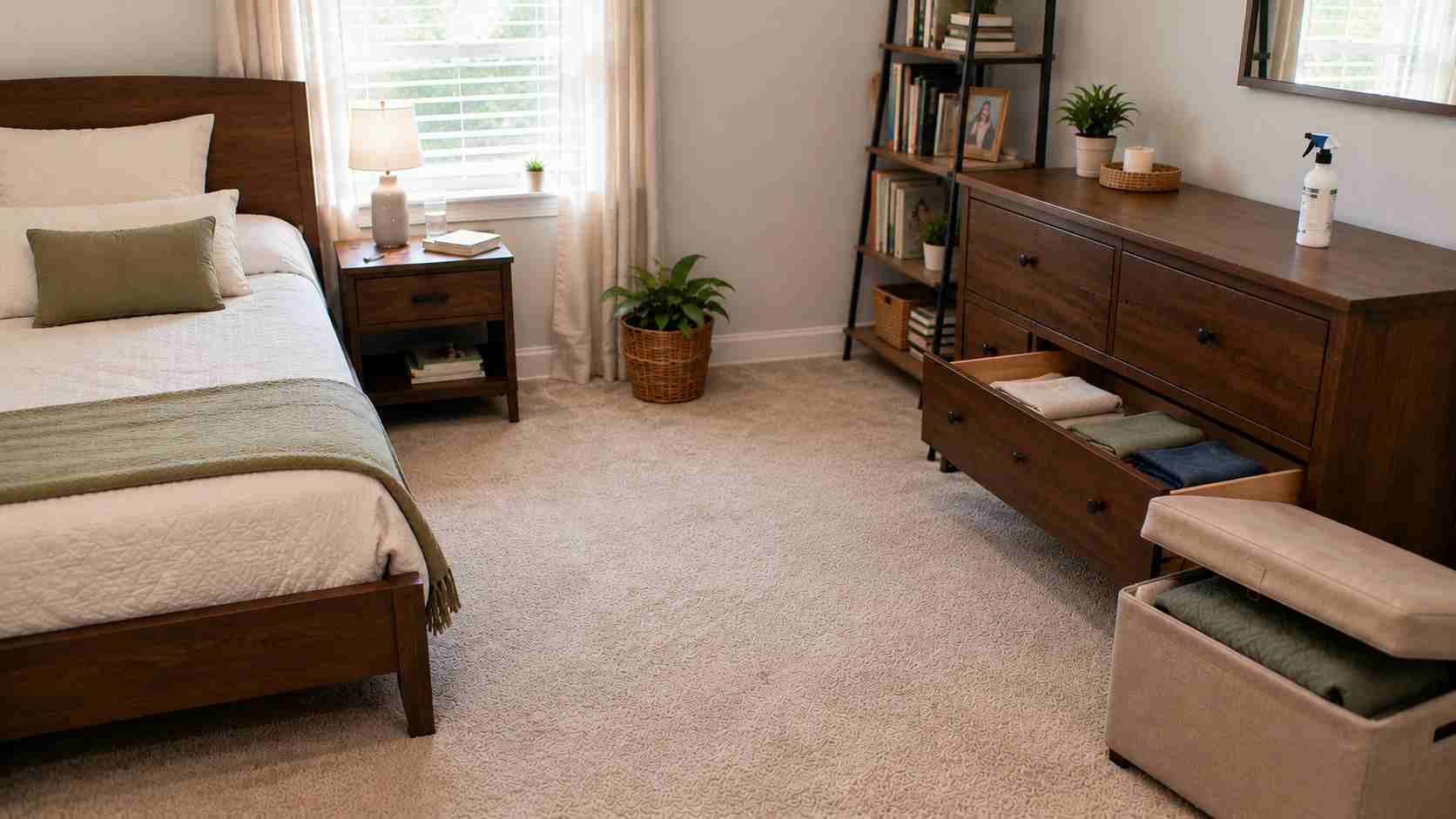
The most forgotten part of a clean bedroom is storage. If you don’t have a smart storage system in place, it’s only a matter of days before clutter creeps back in. That’s why knowing the decluttering mistakes to avoid is just as important as choosing the right storage solutions.
Under Bed Storage: This is the area under a standard queen bed that can be used for about 30-40 cubic feet of storage. Seasonal clothing and extra linens are suitable for flat rolling bins. For bulky items such as duvets, the vacuum-seal bags can cut bulk up to 75%. Do not store items that should be stored in another room; bedside storage is for items that are extra in the bedroom.
Bedroom storage units: A freestanding armoire or wardrobe provides extra storage without the need for a renovation. Basket trays can be stacked on top of open cubes in cube storage units (such as IKEA Kallax), which is a great way to hide away some clutter but still have easy access to it in a small room.
Bedroom storage ideas by space constraint:
| Room Type | Best Storage Solutions |
| Small apartment bedroom | Vertical shelving, ottoman with storage lid, bed with built-in drawers |
| Shared bedroom (couples) | Divided closet system, separate nightstands with drawers, labeled bins |
| Kids’ room | Low open bins for toys, labeled hooks for bags, under-bed rolling trays |
| Master bedroom | Walk-in closet organization system, dresser drawer dividers, bedside caddy |
| Studio/open plan | Room divider with shelving, Murphy bed with integrated cabinetry |
Bedroom Storage Ideas for Clothes: “one in, one out” is the most effective habit. As you put on a new outfit, one is removed. Hang with hangers facing the same direction and facing inward. After 6 months, if it hasn’t been worn (hanger still in), it can be given away.
Clean Bedroom Checklist for Kids
As a parent, you’ll find it much easier when you help your kids develop a clean bedroom, and they will develop good habits for their lives. The most important thing is to create a visual, easy-to-use, and age-appropriate checklist.
Why Kids Need Their Own Checklist
Children have a different sense of clutter in their bedroom. Visual noise refers to the clutter of toys, school items, and clothing that can overstimulate the environment and affect concentration and even increase anxiety, especially for ADHD children. A kid’s bedroom checklist helps them to keep their room tidy, and it makes them feel good about themselves because they are responsible for it.
Clean Bedroom Checklist for Kids: By Age Group
Ages 3–5 (Toddlers):
- Place cuddly toys in their toy box.
- Place books on shelves.
- Put soiled clothes in the laundry basket (low and open on top)
- Make the bed (The only rule is to pull the duvet up; perfection isn’t the aim!)
Ages 6–9 (Elementary):
- Set up the bed by yourself
- Remove toys and clothing from the floor surface
- Clean desk and bedside table surface
- Create ‘keep in room’ and ‘belongs elsewhere’ piles
- Avoid vacuuming, or help with vacuuming, once a week.
Ages 10–13 (Tweens):
- For the first time, it is possible to make the bed in full, with the help of the pillows.
- Use a microfiber cloth to dust surfaces.
- Vacuum the bedroom floor.
- Sort and empty the laundry basket
- Clean up the desk and bookshelf.
Ages 14+ (Teens):
- All of the above, independently
- Learn to change and wash their own bedding
- Spot clean mattress monthly.
- Organise their own cupboards and make donation choices.
Pro tip for parents: Use the checklist as a visual chart (illustrated for younger children, written for older children). Do not link it to a reward system; studies at Stanford found that external rewards cause a decrease in motivation over time for tasks that can be done routinely. Rather, make it a daily ritual, whether it’s in the morning or evening.
How to Maintain a Clean Room
Cleaning your bedroom is one thing. Keeping it clean is the real skill. Most people do not do maintenance because they wait until the room is in such a disheveled state that it is too overwhelming to do.
Daily Habits (Under 5 Minutes)
These micro-habits are the foundation of how to keep your room clean long-term:
- Make the bed every morning. This one is the most studied factor of tidiness during the day in the bedroom.
- Take out all the items that are not in the correct place before leaving the area.
- Do not place soiled clothing on the floor or the chair, but in the hamper.
- Put away your phone, book, and glasses before you go to bed.
Weekly Tasks (20–30 Minutes)
- Change and wash bedding
- Use a microfiber cloth to dust surfaces
- Vacuum the bedroom floor (including under the bed)
- Wipe down mirrors and windows
- Remove anything that has been left in the “wrong” places.
Monthly Tasks (45–60 Minutes)
- Rotate the mattress
- Wash pillow inserts
- Clear off one space (closet, dresser, nightstand, etc.); one space/month is manageable.
- Replace and clean light fixtures and ceiling fan.
- Clean window sills and wipe baseboards
The “Reset” Method
Cleaning schedules are not the most effective maintenance habit; it’s what professional organizers call a “nightly reset.” At night, do the five minutes of ‘baseline’ (bed is made, floor is cleared, surfaces are cleared, hamper is closed). This clears your environment and your mind at the same time, leaving the next morning easier.
When life gets busy, how do you maintain cleanliness in your room? The solution is invariably the same: lower the bar on the daily, and raise the bar on the weekly. 2-minute tidy each day, 2 hours tidy each weekend.
FAQ: People Also Ask
How do I clean my bedroom step by step?
Top to bottom: clean up trash, sort clothes, dust from the ceiling to surfaces, clean the mattress, change bedding, wipe furniture, vacuum/mop floors. The last step of the cleaning process should always be cleaning the floors, to ensure that debris is trapped in the last pass. This sequence will avoid double cleaning.
How long does it take to deep clean a bedroom?
The deep clean bedroom session lasts 2-4 hours for an average-sized bedroom. This involves dusting all surfaces, vacuuming floors, cleaning windows, wiping furniture, cleaning the mattress, washing bedding, and doing other tasks. If you are also decluttering, add 30-60 minutes. It’s easier to do this in zones, over two days.
How often should I clean my bedroom?
Daily light tidying (making bed, clearing floor, surfaces) is suggested. A moderate clean once a week is best, dusting, vacuuming, and changing bedding. A complete deep clean of the bedroom should occur on a regular basis of 3-6 months. Mattresses should be rotated and vacuumed monthly, and completely treated with baking soda every 3-6 months.
What is the fastest way to clean a really messy bedroom?
Work on it in passes, not zones. Pass 1: Pick up all trash, soiled clothing (5 min). Pass 2: Move all flat surfaces to one central location (5 min). Pass 3: Sort the pile – keep, donate, belongs elsewhere (10 minutes). Pass 4: Make the bed (3 min). Pass 5: Vacuum (5 min). Total: less than 30 minutes for a visible change.
How do I clean a bedroom mattress at home?
Strip bedding, vacuum the entire mattress surface, including sides. Spot treat stains with dish soap and cold water (or hydrogen peroxide for protein stains). Sprinkle a lot of baking soda and allow it to sitfor 2-4 hours. Thoroughly vacuum the baking soda. Turn the mattress over by 180 degrees. To make cleaning the mattress even easier in the future, use a mattress protector.
What are the best bedroom storage solutions for small spaces?
For small spaces, prioritize vertical storage: tall wardrobes, floating shelves above eye level, and over-door organizers. Use the under-bed space with flat rolling bins or a bed frame with built-in drawers. An ottoman or storage bench at the foot of the bed adds seating and hidden storage. Vacuum-seal bags reduce linen bulk by up to 75%.
How can I keep my room clean with kids?
Create a visual checklist at kid height and tie it to the daily routine (after school, before dinner). Use labeled, open-top bins rather than lidded containers; kids are far more likely to use storage they can access in one motion. The fewer decisions they have to make (where does this go?), the more consistently they’ll tidy independently.
What makes a bedroom feel cleaner without cleaning it?
Three immediate wins: make the bed, clear the floor, and improve the lighting. A neatly made bed changes the room’s entire feel. One tidy floor creates openness. Swapping overhead lighting for warm lamp light at 2700K softens the room and draws less attention to imperfections. A subtle room spray or linen spray adds a sensory layer of freshness.
Conclusion
The cleaner the bedroom, the better the sleep quality, mental clarity, and mood will be. Making a bedroom clean is a high-return investment. There are three things to remember from this guide:
Don’t clean; declutter first. There’s no such thing as scrubbing a room too clean. The first step is always to get rid of the excess.
Create systems, not habits. Having smart bedroom storage solutions and a clean bedroom checklist ensures that maintenance is nearly automatic.
Always clean top to bottom. This one sequencing tip will avoid rework and make each clean bedroom session more efficient.
Whether you’re doing a quick reset or a full deep-clean bedroom session, the goal is the same: create a space that feels calm the moment you walk in.
Make your bedroom the best room. Now go make it one.