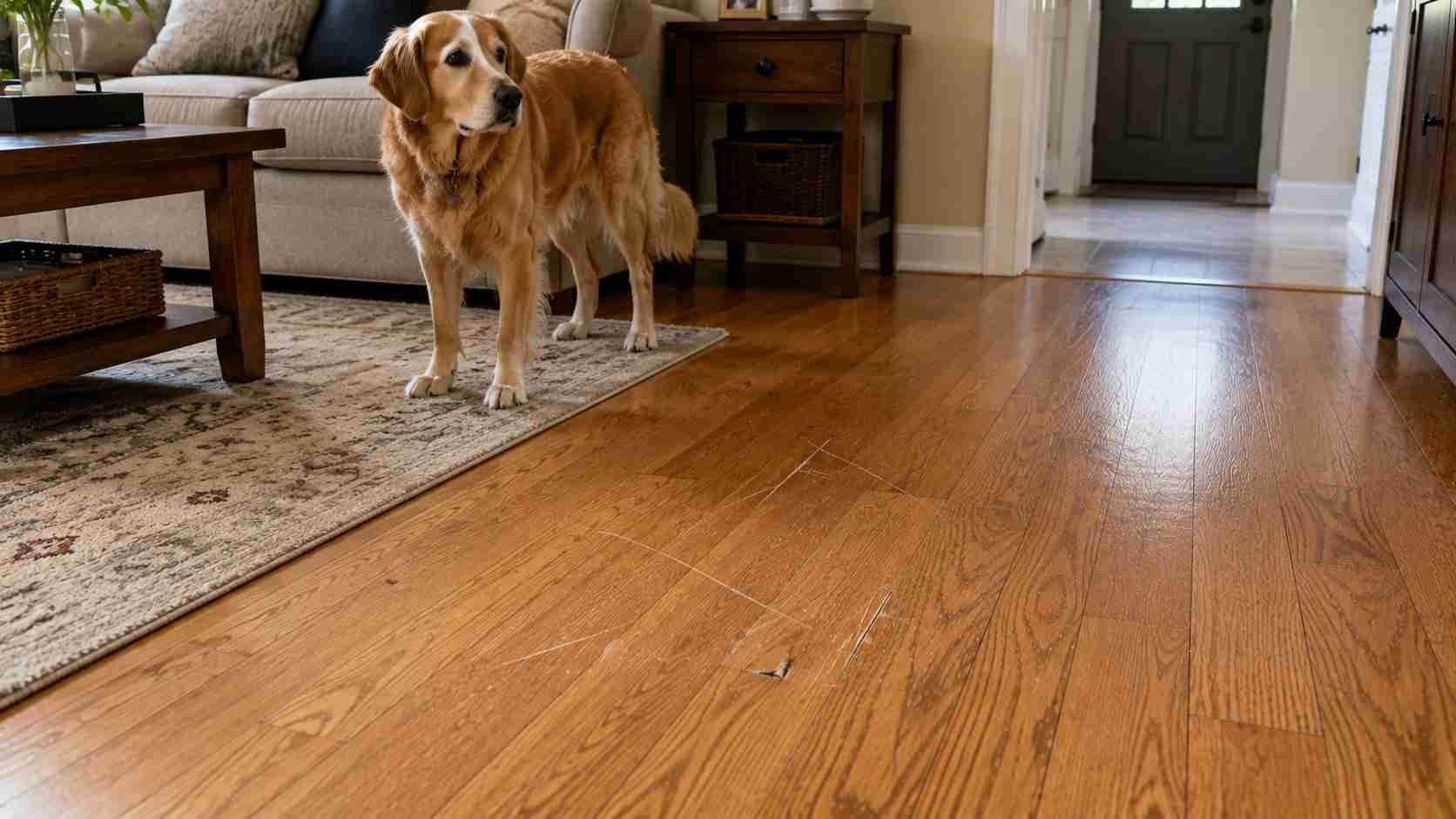
About 65 million U.S. homes have hardwood floors, and a significant number of those homeowners are looking for the same answer at this very moment: how to clean up dog scratches on hardwood floors without refinishing the entire floor. The good news? Repairing most surface scratches on hardwood floors will take less than an afternoon and will typically cost less than $30; for deeper claw gouges, the entire room should not be sanded.
In this guide, you’ll learn how to identify how bad your scratches really are, the exact step-by-step process to treat dog scratches on hardwood floors, how to fix dog scratches on wood floors without sanding, techniques for engineered hardwood and laminate, how to buff out dog scratches on hardwood floors, and most importantly, how to prevent dog scratches on wood floors from happening again. If you are renovating, we will also discuss dog hair, dog urine damage, and the best dog-proof flooring options.
1. Why Do Dogs Scratch the Floor?
Before fixing scratches on wood floors from dog claws, it’s best to understand the cause of the scratching; otherwise, you’ll be here again in 6 months.
Instinctual Digging and Nesting
Dogs evolved a denning instinct from their wild canid ancestors, who made shallow nests before lying down. But even though there’s no dirt to move on hardwood, that same movement, pawing and turning in a circle, manifests as dog nail scratches.
Anxiety, Excitement, or Boredom
Scratching tends to be triggered by certain times, such as when someone is at the door, during feeding time, during thunderstorms, or when separated. Most deep gouges come from dog activity such as zoomies and quick turns in high-energy or under-exercised dogs on a wood floor.
Long or Untrimmed Nails
This is the most controllable factor. Trim your dog’s nails regularly to keep them from reaching the floor. When your dog’s feet are flat on the ground, nails that touch the surface are long enough to catch and dig into the finish with every step, sprint, and jump landing.
2. How to Assess Scratch Severity Before You Start
Not all marks require the same repair. Perform a fingernail test (scratch with the nail). If the nail gets stuck, the finish (and even the wood) is ruined. Identifying the scratch depth early helps you choose the right repair method and protect wood floors from further damage.
| Severity | What It Looks Like | Best Fix |
| Light surface scuffs | Dull marks, finish intact, no catch | Cleaning + polish or wax |
| Moderate scratches | Finish is broken, nail catches slightly | Wood filler, stain markers, buffing, spot-refinish |
| Deep gouges | Bare wood visible, splintering, nail catches strongly | Wood filler + stain + sealant, or professional spot sanding |
| Structural damage | Warping, cracked boards, multiple deep gouges | Board replacement or full refinish |
Fortunately, for most homeowners who are experiencing dog claw scratches on hardwood floors, the problem they’re facing is one of the first two, which is good news because these are DIY-friendly.
3. How to Treat Dog Scratches on Hardwood Floors (Step-by-Step)
This is the essential, most-searched process, so we’re going to go beyond a simple 10-step list, with the “why” behind each step so you don’t make it worse.
Step 1: Clean the Area Thoroughly
Vacuum, then clean with a wood cleaner (not an all-purpose cleaner that may leave a residue, which will stop filler and stain from bonding). Allow to dry completely (at least 15-20 minutes).
Step 2: Test for Finish Type
Use mineral spirits to wipe down a hidden area. If color transfers, it is an oil-based finish; otherwise, it is probably water-based polyurethane. This will dictate which repair products will bond properly.
Step 3: Fill, Blend, and Seal
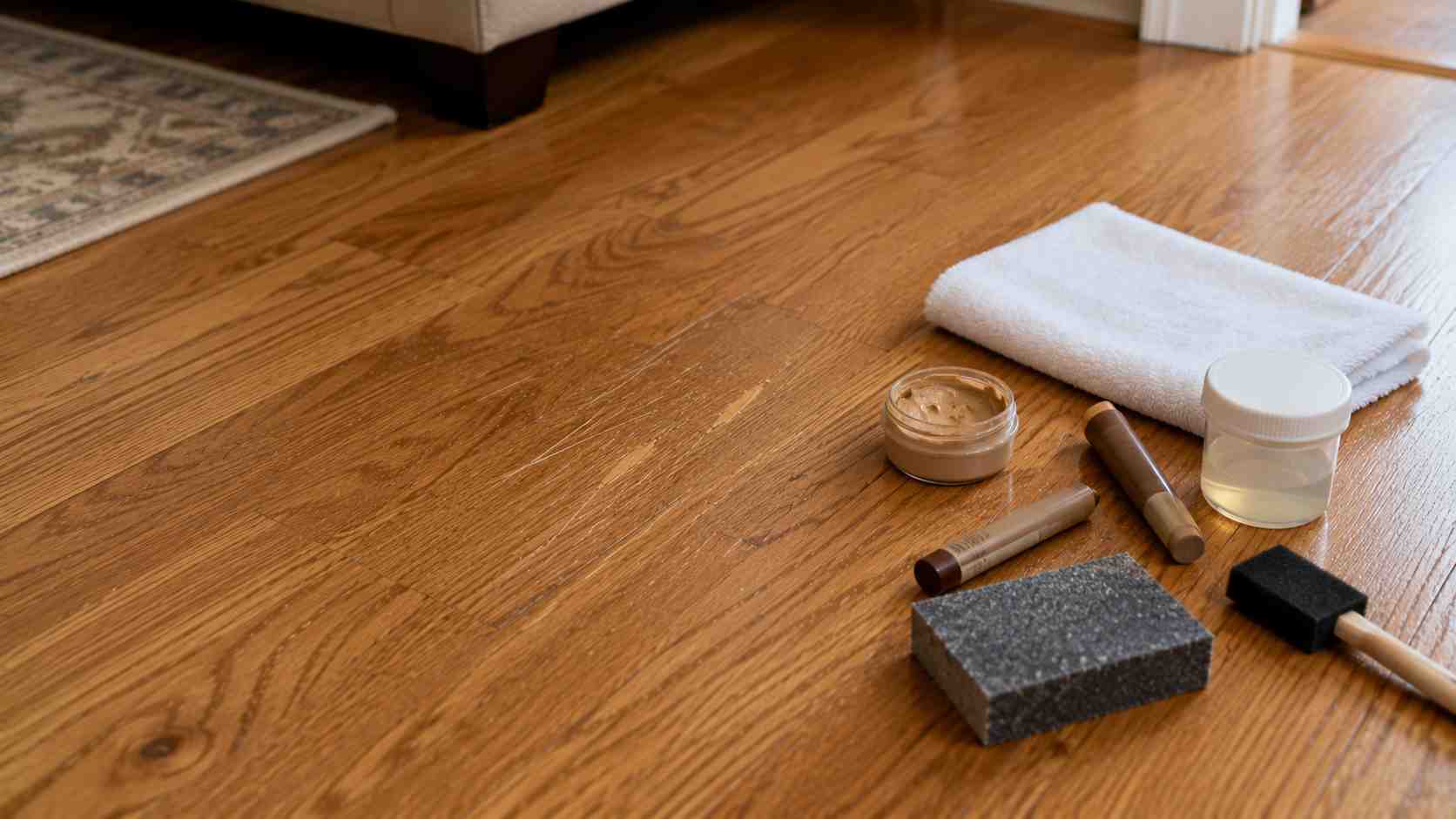
For light or moderate marks, use a wood filler pencil or putty, apply it on the grain, and buff it down afterwards when dry, using a color match. If scratches are deeper, fill with wood filler and apply matching stain and a top coat of polyurethane as before, letting the wood filler cure according to the instructions on the container (usually 24 hours) and sand lightly with 220-grit sandpaper before applying the top coat.
Step 4: Cure Before Foot Traffic
Do not allow pets to be in the repaired area for 24-48 hours. This is the most important step that most guides miss, and it’s why DIY repairs tend to fail early: A soft top coat absorbs new scratches before it cures.
4. How to Fix Dog Scratches on Wood Floor Without Sanding
Not every joint requires sanding, and it saves time, dust, and money. When a no-sand strategy is right and how to do it right.
When You Can Skip Sanding
If the scratch does not catch a fingernail mark or only just does, you may be a candidate for a “no-sand” fix. This also applies to most dog scratches on laminate wood floors, as they can’t be sanded at all without damaging the wear layer.
Renewing Products That Work
- Wax fill sticks: Used to fill shallow scratches, melts and blend.
- Touch-up markers (in oil): Suggested for finish-only scratches; dry in a few minutes.
- Floor restorer/rejuvenator products: These are applied as a mop-on finish, filling micro-scratches all over a room and giving it sheen; the best alternative to a floor “reset” without refinishing.
The Walnut Trick (and Why It Actually Works)
Oils and tannins present in the raw walnut cause the mark to be darkened and filled by rubbing it over a light scratch. It’s a real quick fix for very light dog scratches on hardwood floors, but it’s not a permanent seal, so if you want a lasting effect, apply a matching polish to the floor.
5. Fixing Scratches on Engineered Hardwood and Laminate
While most competitor guides are the same, engineered hardwood and laminate require different handling; if not, the floor is in danger.
How to Fix Dog Scratches on Engineered Hardwood Floors
Engineered hardwood comprises real wood veneer (usually 0.6mm to 6mm) and plywood layers. Light scratches can be filled and buffed with color-matched filler and polish. But since the veneer is thin, engineered floors typically just need one or two light sandings in their lifetime (sanding should be done only for deep gouges, and use fillers and markers as much as possible).
Repairing Dog Scratches on Laminate Wood Floors
Laminate does not actually have wood to sand or stain; it is an image layer printed on a protective layer. Repairs are dependent on:
- Laminate-specific repair putty in a matching shade
- Burn-in crayon kit (heated wax fillers) for deeper gouges
- Complete plank replacement for all items that penetrate the wear layer, as there is no way to completely hide the damage to the printed pattern with filler.
6. How to Get Dog Scratches Out of a Wood Door
As with floors, dog pawing to get in and out of the house is the most common cause of door scratches, but there is one extra step involved in the wood repair.
Step 1: Assess the Paint or Stain Finish
Matching touch-up paint should be used on painted doors after filling, and matching stain on stained doors (tested at the edge of the door, where it is not visible).
Step 2: Fill and Feather
Use wood filler for gouges, and feather the edges with fine sandpaper so that the repair doesn’t stand out.
Step 3: Add a Scratch Guard
The most important long-term solution is the clear acrylic door scratch guard; it’s a thin plastic strip placed at the height of the paw at the door to stop any future scratching from reaching the wood.
7. How to Prevent Dog Scratches on Wood Floors
The other half of the equation is repair. The truth is, it’s prevention that will save your floors in the long term.
Nail Maintenance Routine
Keep nails trimmed to 3-4 weeks or use a rotary tool to grind them weekly; a round and smooth edge will catch less than a freshly cut nail. If you can hear clicking on hardwood as your dog walks, nails are too long.
Rugs, Runners, and Paw-Friendly Zones
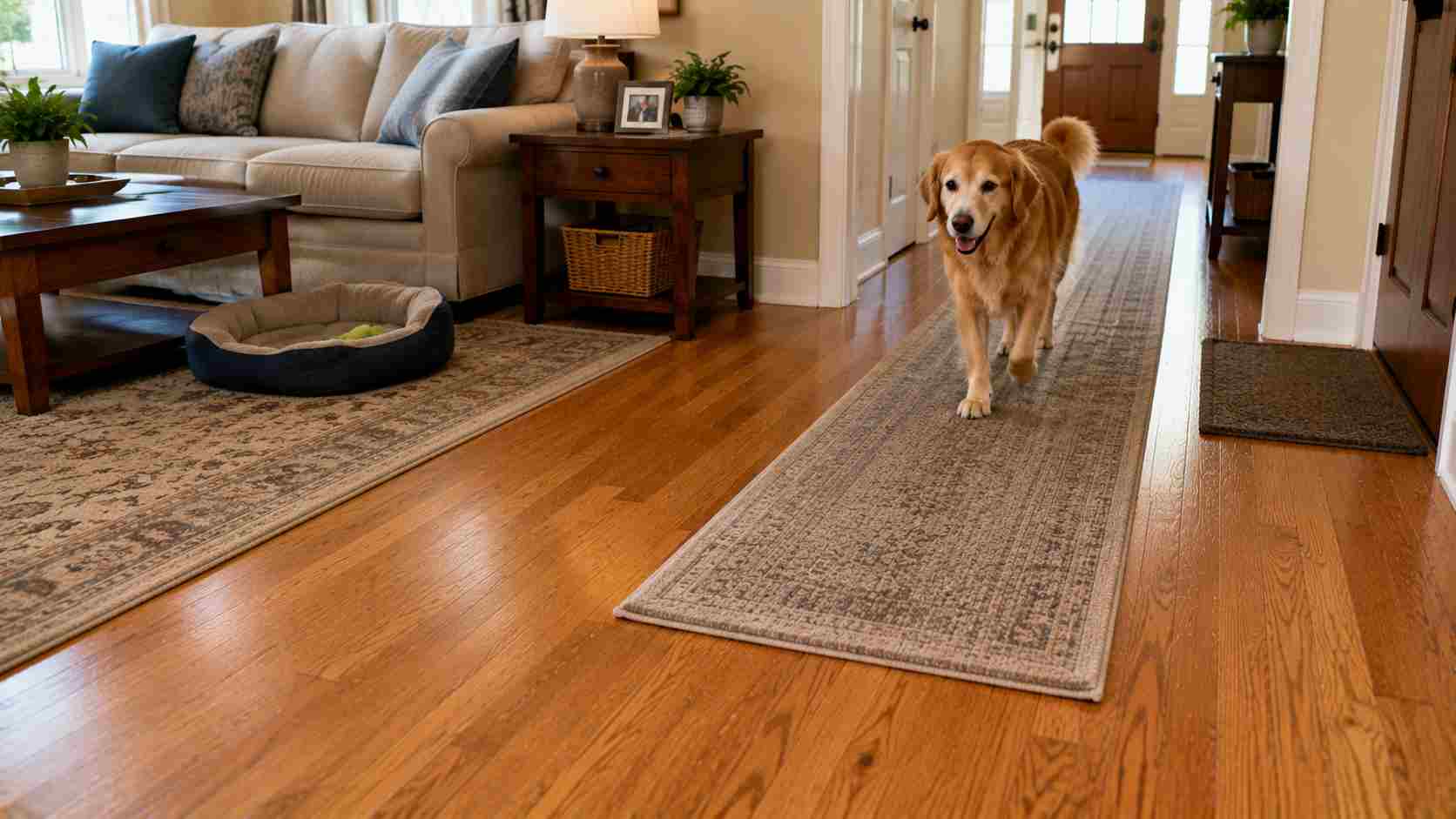
Use runners on high-traffic areas (entryways, hallways to the door, favorite window watching places) and non-slip mats in play spaces. This is the quickest and cheapest solution to stop dog claw scratches on hardwood floors right away.
Behavioral Management
Train dog to “go to place” to eliminate door-greeting scratching; burn off excess energy with daily exercise; bored/under-exercised dogs scratch and dig more at doors and on floors.
Protective Finishes
Standard polyurethane is more susceptible to scratching and is more difficult to touch up than a higher-durability topcoat (aluminium oxide finishes on engineered products or a hard-wax oil finish that can be spot-repaired).
8. Dog Hair, Dog Urine, and Hardwood Floors: What You Need to Know
But scratches aren’t the only floor problem that dog owners have; hair and urine are a regular occurrence in the same topics, so let’s fill that gap.
Best Way to Pick Up Dog Hair on Hardwood Floors
Standard brooms tend to push hair into spaces, whereas rubber-bristle brooms and vacuums with a hardwood-floor setting (no beater bar) work better. A slight damp microfiber mop pass after that collects fine static-clinging hairs that a vacuum will not.
Will Dog Urine Ruin Hardwood Floors?
Yes, dog urine stains on wood floors can happen, and they can be more serious than scratches. Ammonia and uric acid present in urine can permeate the finish seams, leaving stains, warping, and odors that can penetrate subflooring if not properly treated. Use an enzymatic cleaner (not paper towels) to clean accidents right away; enzymatic cleaners will break down uric acid, not just cover up the smell. Water that has been left standing in puddles for over 15–20 minutes is more likely to cause permanent staining.
9. Best Dog-Proof Flooring Options (If You’re Renovating)
If you’re renting, remodeling, or simply tired of repairs, it’s worth comparing flooring built for dogs and hardwood households.
| Flooring Type | Scratch Resistance | Urine Resistance | Cost (per sq ft) | Best For |
| Solid Hardwood | Low–Moderate | Low | $8–$15 | Homeowners who love authentic wood and don’t mind refinishing |
| Engineered Hardwood | Moderate | Low–Moderate | $6–$12 | Buyers wanting a wood look with slightly more durability |
| Laminate | Moderate–High | Low | $3–$7 | Budget-conscious, moderate-traffic homes |
| Luxury Vinyl Plank (LVP) | High | High | $4–$9 | The top pick for dog-proof flooring — waterproof and scratch-resistant |
| Tile | Very High | Very High | $5–$14 | High-traffic, accident-prone households |
Vinyl Dog Floor has full waterproofing and a scratch-resistant wear layer. This makes rigid-core LVP the perfect dog flooring material that can solve the problems of scratching and urine damage.
FAQ: Frequently Asked Questions
Can dog scratches on hardwood floors be fully removed?
Filler, stain, and refinishing can completely remove light and medium scratches. Deep gouges into the grain of the wood can be reduced to almost imperceptible, but will show some texture change when raked in lighting.
How much does it cost to fix dog scratches on hardwood floors?
The DIY kits, including the filler, markers, and restorer, range in price from $15 to $50. Spot-refinishing will range from $3 to $8 per square foot, and full-room refinishing averages $3 to $8 per square foot, depending on the region and the condition of the floor.
What is the best way to fix dog scratches on hardwood floors for beginners?
The easiest way to get into it is with color-matched wax fill-sticks or touch-up markers; there is no sanding, no drying time for stains, and mistakes can be scrubbed away with mineral spirits before they set.
Do rugs really stop dog scratches on wood floors?
Yes. Rugs or runners over paths your dog uses most (entryways, window spots) reduce the direct contact with wood in the highest wear areas by a factor of 10 when it comes to new scratches.
How often should I trim my dog’s nails to prevent scratches?
Most dogs: every 3–4 weeks or when you hear hardwood clicking. Trims on active or working breeds may be required every 2–3 weeks, as their nails wear differently than those of dogs that are not active or working.
Is laminate or hardwood better for dogs?
Laminate is more resistant to scratching than solid hardwood, but is not waterproof and cannot be refinished. In terms of durability and resistance to urine, luxury vinyl plank is better than both concrete and other types of flooring for most dog homes.
Will dog urine ruin hardwood floors permanently?
It can, if not treated. Usually, staining is avoided by cleaning promptly with an enzymatic cleaner; however, repeated or extended exposure may result in staining and a need for board replacement.
How do I buff out dog scratches on hardwood floors myself?
Clean, then use a floor restorer or matching wax, and buff with a soft cloth or buffing pad, working in the direction of the grain, until the sheen is the same as the rest of the floor.
Conclusion
Dog scratches on hardwood floors are one of the most common and easily rectified issues that pet-owning homeowners have. Three points to note: If the mark is serious, consider a repair; most marks can be repaired without sanding; and second, evaluate the severity of the mark before deciding on the repair. Second, prevention is as important as repair; otherwise, you’re doing the work over again (regular nail trimming, rugs in high-traffic areas, and a durable topcoat). Third, for renovating homes, dog-proof flooring like luxury vinyl plank addresses scratching and urine damage at the same time.
Try the fingernail test on your worst scratch today, select the matching fix above, and by this weekend, your floor should look restored, and you’ll never need a professional refinishing service.