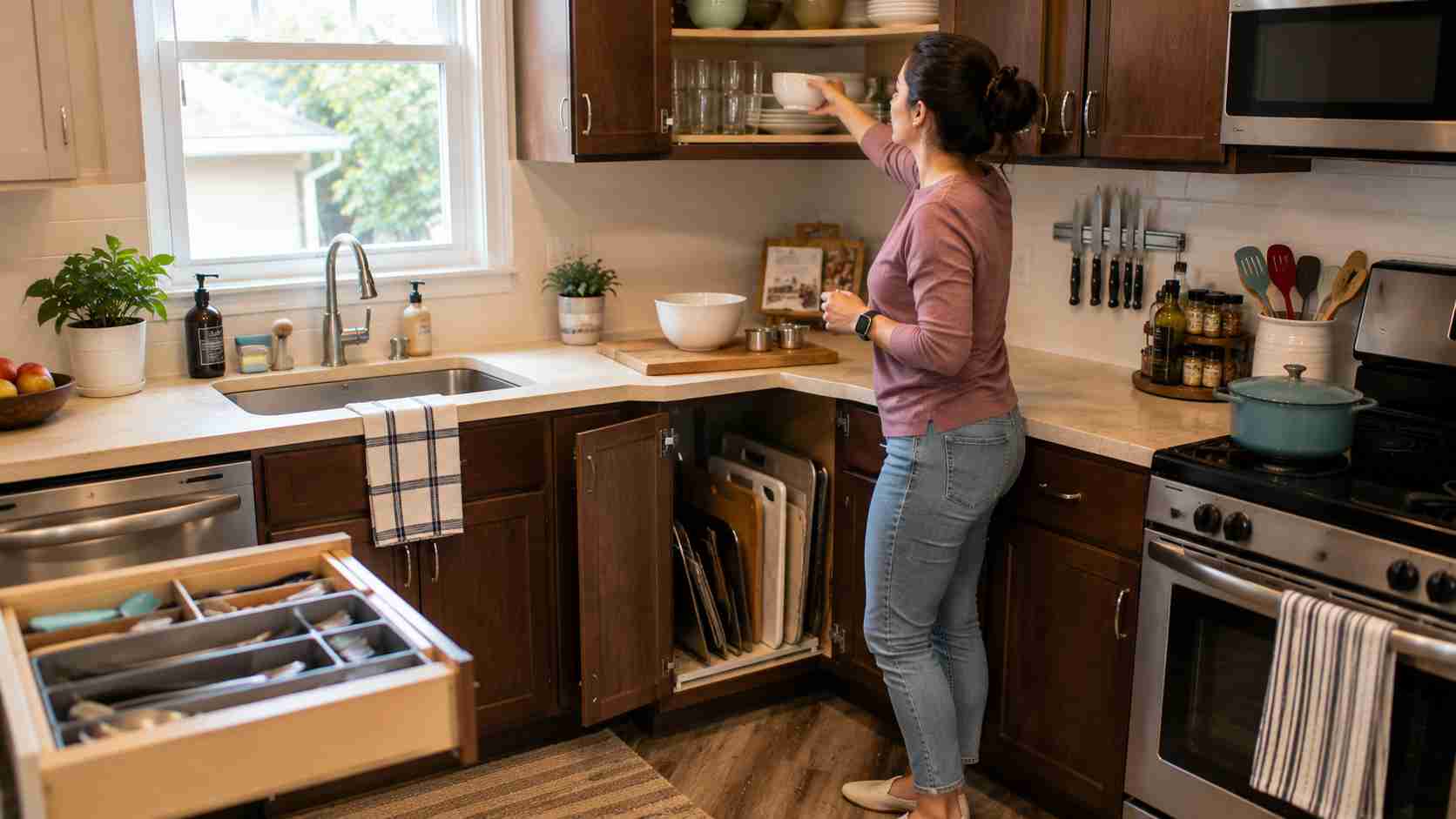
Ever wonder how much time you’re spending in your unorganized kitchen looking for things? That’s more than 160 hours per year wasted due to clutter, missing lids, and stuffy closets. From a galley kitchen in a tiny apartment to a full kitchen for the whole family, the best kitchen organization hacks can save you time and stress and get you back to enjoying cooking.
The bright side is there’s no need for a renovation budget or a professional organizer to solve it. The majority of the best kitchen organization ideas are under $30, and many are free of charge.
You’ll find the best kitchen storage tips on a budget, the smartest small kitchen storage ideas without cabinets, DIY solutions you can make this weekend, and an overview of the best kitchen storage solutions for each area of your kitchen (counters, cabinets, under-sink storage, etc.).
Why Kitchen Organization Fails (And How to Fix It First)
The majority of kitchen decluttering organization projects are unsuccessful, not because the ideas are wrong, but because they lack one critical step: establishing zones before purchasing any items.
This is referred to as the “zone-first” principle by professional organizers. All items in your kitchen should be given a logical zone, where they fit based on how they are used in cooking, before a single bin or shelf is put up. The National Association of Professional Organizers says that a kitchen organized by workflow zones keeps things tidy for 3 times longer than a kitchen organized by the type of items.
The Three-Zone Rule
Create 3 functional areas in your kitchen:
Prep Zone: cutting boards, knives, mixing bowls, and measuring tools by your biggest open counter surface.
Cook Zone: pots, pans, spices, and frequently used utensils close to the stove.
Clean Zone: dish soap, sponges, drying rack, and cleaning sprays near the sink
If anything is not in a zone, it is re-evaluated. If it’s not used for six months, it’s a candidate for donation. This one audit step, performed before purchasing any organizers, is the key to organization that lasts versus organization that becomes a mess by March.
The “Touch It Once” Rule for Kitchen Beginners.
The simplest of kitchen hacks for the beginner is the “touch it once” rule: before touching anything else, the item you touched while preparing the meal must be returned to its proper place. Easy to say but difficult to do, with clear visual cues (labeled bins, color-coded zones), kitchen reset time is reduced by almost half.
Best Hacks for Kitchen Cabinet Organization
Most kitchens have the least-used storage space in the form of cabinets. The typical upper cabinet uses 40-60% of its vertical space inefficiently by storing items flat on their shelf instead of stacking or layering intelligently. These are some of the most effective storage hacks for kitchen cabinets, from highest to lowest effect.
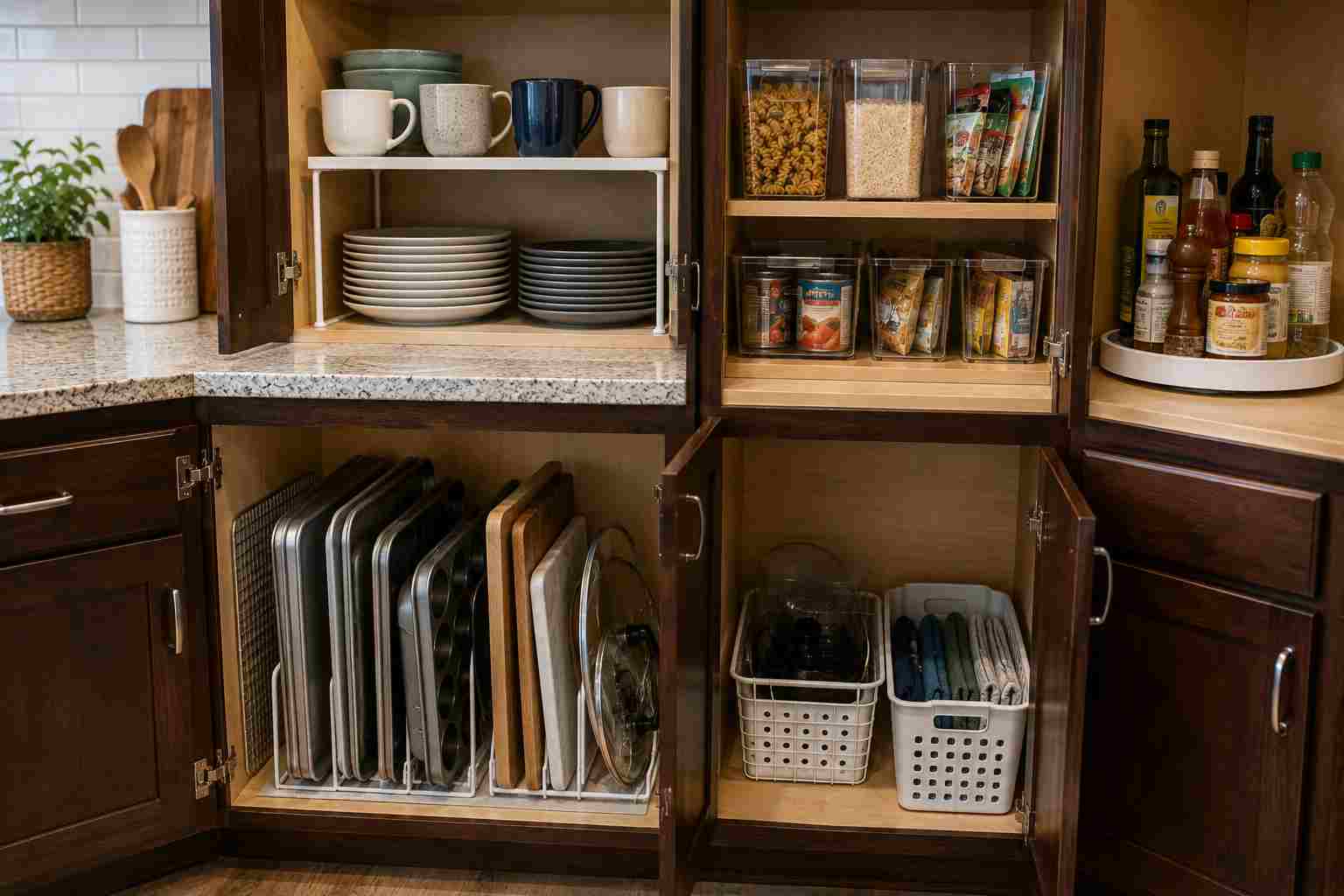
Vertical Dividers for Bakeware and Cutting Boards
Instead of stacking sheet pans, cutting boards, and muffin tins horizontally so the one you need is always the bottom one, store them vertically on tension dividers or a simple file organizer that’s been repurposed for the kitchen. This is one of the best kitchen cabinet organization ideas that you can get right here, and now that will have a high return on investment.
A regular tension divider set will set you back $8-$12 and will provide access to all the pans without lifting a pile. Interior designers say this trick also works for lower cabinet lids, trays, and serving plates.
Stackable Shelf Risers to Double Cabinet Depth.
Shelf risers (also known as cabinet shelves or stacking shelves) are placed on top of the existing shelf surface and provide a second shelf (doubling your storage space without drilling or permanent mounting). They’re ideal for:
- Establishing a system of mugs above and plates below
- Sorting out everyday dishes from occasional dishes
- Organizing spices without digging row by row.
Search for adjustable-width risers (typically two for $15-$18) to fit cabinets of various depths. This is one of the simplest, professional-looking, and cheap DIY kitchen organization solutions.
Clear Bins with Labels: The Cabinet Game-Changer
Professional organizers say that the single most recommended item is clear bins with labels, both printed or handwritten, and it makes sense. Keep common foods like pasta, rice, canned items, and snacks organized in labeled bins so you never dig, never forget the expiration date,e and always know when you’re low.
The most important improvement that is not discussed in most articles: Take out their packaging before putting them in bins. Granola bars occupy twice the space of the container that they are in. Transfer to bins and store about 30-40% more in the same cabinet.
Pull-Out Cabinet Organizers for Corner and Deep Cabinets
The two storage spaces that are the black holes of the kitchen are corner cabinets and deep base cabinets. Pull-out organizers (lazy Susans, two-tier pull-out drawers, or sliding cabinet inserts) transform dead space into accessible storage. A custom pull-out insert costs $150-$400 installed, while standalone turntable versions are $20-$35 and come with no installation.
Kitchen Counter Organization Ideas That Actually Clear Space
The most hotly debated real estate in any kitchen is counter space. The purpose of an organized kitchen counter is not to be minimalist for the sake of it; it’s about strategic visibility. Effective kitchen countertop organization ideas focus on keeping the things you use daily within easy reach while giving everything else a designated place. The things you use daily earn counter space; all other things must have a dwelling place.
The “Daily 5” Counter Rule
Interior organizers suggest the “Daily 5” rule: five categories or fewer of items should reside on your countertop on a permanent basis. These are usually: a coffee station, a knife block, a small appliance (toaster or kettle), a utensil holder, er and paper towels. Any items outside of that go to a special storage area.
This is especially true in the small kitchen counter organization ideas, as it is a rule that encourages prioritization and not accumulation.
Tiered Counter Organizers for Vertical Storage
If space is tight, then go up. A 2- or 3-tier countertop organizer can convert a 12″ footprint into 36″. These are particularly suited to:
Spice organization: tiered spice racks keep all bottles visible without digging
Coffee station supplies: filters, pods, sweeteners, and mugs on display
Mail and recipe cards: a tiered paper organizer keeps the counter clear while functional
Magnetic Knife Strips: The Underrated Counter Saver
The majority of kitchens are losing valuable counter space and drawer space on knife blocks. All knives are contained in one visible, accessible row with the help of a magnetic knife strip attached to the backsplash (or side of cabinet), saving up to a 9-inch x 9-inch counter space. The installation process is simple, requiring approximately 10 minutes, and the hardware is generally $20-$35.
Knives on a magnetic strip will also not dull each other since they don’t bump into other knives or drawer dividers, as a bonus.
Organization Hacks and Ideas for Kitchen Counters: The “Appliance Garage”
A small cabinet or sectioned-off area in the back of the counter with doors or a roll-top cover for small appliances is one of the more ingenious organization hacks and ideas for kitchen counters. The counter is totally clear when closed. The toaster, coffee maker, and blender are in place when opened.
It can be done by using a repurposed cabinet mounted at counter height or by using IKEA’s SEKTION line with customisations for less than $100.
Small Kitchen Storage Ideas Without Cabinets
You’re right. Keeping your paragraph unchanged and only adding the related phrase naturally:
No cabinets, no pantry, and limited room are the biggest problems for many people who live in apartments or small spaces. If you’re looking for ways to make a kitchen island, a compact movable island can add much-needed storage and workspace without requiring a full renovation. These are some of the best little storage tips for a kitchen without cabinets that work in small spaces where traditional suggestions don’t.
Floating Shelves: The Vertical Square Footage Solution
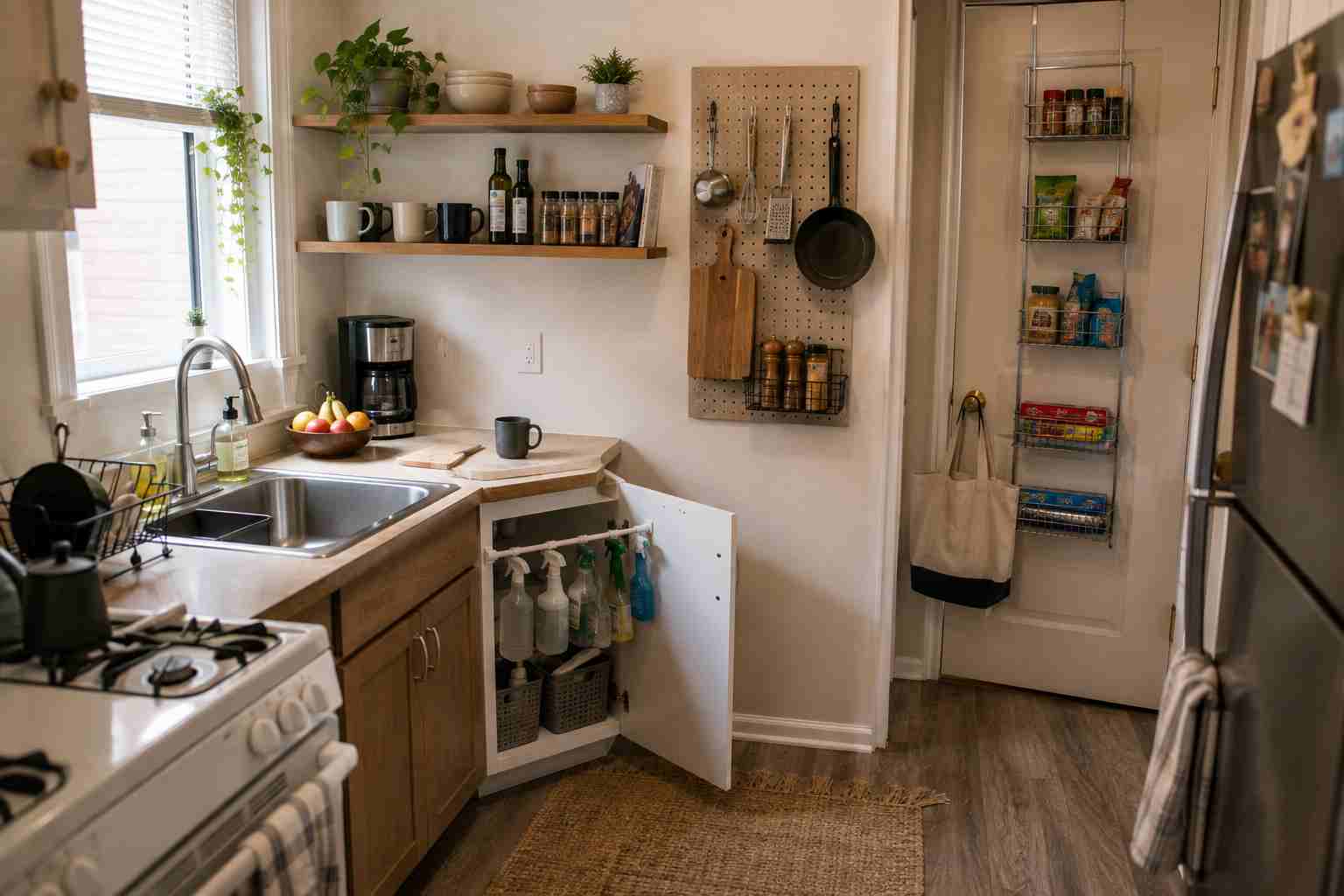
The floating shelves are the most dramatic single addition that can be made to a kitchen with inadequate cabinetry. A 36-inch floating shelf close to the stove will fit spices, oils, a cookbook stand, and a line of mugs; half a cabinet’s worth of storage with no floor space wasted.
The price of installation can vary from $15 (the basic bracket and board from the hardware store) to $80 (finished wood with hidden brackets). For renters, Command Strip-rated floating shelves can support up to 7.5 lbs with no damage to the wall.
Over-the-Door Organizers
The back of pantry doors, cabinet doors,s and even the back of the kitchen door are frequently left unused. Over-the-door organizers (wire, fabric,c or clear pocket) can hold:
- A collection of spices and small bottles of condiments.
- Snack bags and wraps.
- Cleaning supplies (on under-sink doors)
- Snacks within easy reach for children.
An over-the-door spice organizer can accommodate 24-36 jars and ranges in price from $15 to $25. One of the quickest and easiest small kitchen organization ideas for families is to mount one on the inside of the pantry door in less than 20 minutes.
The Fully Customizable Wall Storage System: Pegboards
One of the most versatile and useful small kitchen storage ideas is a pegboard attached to an unused kitchen wall. Hooks, shelves, bins, and holders can be moved around as requirements change. A 24″ × 36″ pegboard system can store a complete set of pots and pans, tools, cutting boards, and a spice rack (all off the counter, off the cabinet shelves).
The cost of DIY pegboard kits is $25 – $50, and the installation takes about an hour. For most renters, this is the best they can do without having to spend over $50.
Tension Rod Tricks Under the Sink
The under-sink cabinet is one that is difficult to organize because of the plumbing. One of the best kitchen storage ideas is a tension rod hanging horizontally across the cabinet, which will allow you to hang spray bottles and leave the bottom of the cabinet clear for bins and baskets. One $5-$8 tension rod transforms unusable dead space into a functional cleaning-supplies station.
How to Organize Kitchen Appliances (Without Countertop Chaos)
One of the most frustrating things about the kitchen is knowing where to store all the tools, and when they all seem to be necessary. There are more than 20 small appliances in the average American kitchen, but most are used less than once a month.
The Appliance Frequency Audit
Before organizing kitchen appliances, run a frequency audit. Sort every appliance into three categories:
| Frequency | Storage Location | Examples |
| Daily / every other day | Counter or appliance garage | Coffee maker, toaster, kettle |
| Weekly | Accessible cabinet shelf | Stand mixer, air fryer, blender |
| Monthly or less | High shelf or pantry top | Waffle maker, ice cream machine, bread maker |
The one major kitchen appliance organization idea is to store small appliances by frequency instead of size. It maintains your workflow and keeps your counters clear.
How to Store Appliances in Cabinets Without Scratching
Place appliances on non-slip shelf liners or smooth sections of cutting boards on lower shelves or in deep cabinets or pantry shelves to make them easier to slide out and less likely to scratch. On slippery surfaces, appliances can be pulled forward without lifting, which is important when you have a heavy stand mixer on a deep shelf.
A lift-top cabinet insert (also known as a mixer stand) will bring the mixer to counter height in one motion, solving the “lift a 25 lb machine” issue altogether for stand mixers. These run $80–$150 installed.
Cord Management for Small Appliances
The #1 source of appliance-storage chaos is loose cords. Two solutions work well:
The Velcro cable ties ($6 a pack of 50) are wrapped around each cable to prevent it from tangling with other cables.
Cord hooks on the inside of cabinets hold each appliance’s cord in place, ready to go without having to untie a knot.
This is one thing that could make an organized cabinet even when it’s packed with appliances.
Cheap DIY Kitchen Organization Ideas Under $20
You don’t have to buy a $200 kitchen at The Container Store to have a beautifully organized kitchen. The following are the top hacks for organizing your kitchen on a budget, and they’re all under $20.
DIY Drawer Dividers using Cardboard
Before buying a $30 drawer organizer for the utensil drawer, try this. Cut cardboard strips from an Amazon box and make customized drawer dividers that fit your utensil drawer. Use contact paper to cover for a neat appearance. Total cost: $0. They come as a surprise, as they last for 6-12 months before replacement.
A permanent version is made by cutting thin craft wood (from a hardware store, $5-$8) to width and hot gluing it into a grid. It is a very popular DIY kitchen cupboard organizer on Pinterest and is a lot less expensive than retail versions.
Repurposed Magazine Files as Pan Organizers
Magazine files keep sheet pans, lids, and cutting boards organized vertically inside lower cabinets. You can pick them up for about $1 to $2 each at dollar stores. Label the spine of each file for an easy-to-use, at-a-glance system. For less than $10, a set of four files will fit the majority of awkward flat items in most kitchens.
Organize your refrigerator and pantry with Dollar Store Bins.
Name-brand container sets for pantry and fridge organization are great, but so are clear plastic bins from the dollar section of Target, Dollar Tree, or a dollar store. Four matching bins for $4–$8 will provide a uniform, clean look and will make everything easier to find.
A handy tip: make sure to measure your shelves before purchasing. The most frequent error for budget bins is purchasing a bin that is too deep for the shelf, and having to make another trip.
Tension Rods as Vertical Dividers.
In addition to the under-sink trick, you can use tension rods to make instant dividers in a cabinet for baking sheets, cutting boards, and muffin tins (no drilling, no permanent installation). Two $3–$5 tension rods can create a 3-section vertical file system inside any cabinet. This is one of the quickest kitchen hacks to store that will give you a visible impact right away.
Kitchen Organization Comparison: Methods, Costs & Results
| Organization Method | Best For | Avg. Cost | Difficulty | Storage Gain |
| Floating shelves | No-cabinet kitchens, renters | $15–$80 | Medium | High |
| Stackable shelf risers | Cabinet interiors | $12–$18 | Easy | Medium-High |
| Pegboard wall system | Small kitchens, apartments | $25–$50 | Medium | High |
| Tension rod dividers | Under-sink, pan storage | $5–$15 | Easy | Medium |
| Pull-out lazy Susan | Corner cabinets, pantries | $20–$35 | Easy | High |
| Over-the-door organizer | Spices, snacks, cleaning supplies | $15–$25 | Easy | Medium |
| Magnetic knife strip | Counter + drawer space | $20–$35 | Easy | Medium |
| DIY drawer dividers | Utensils, junk drawer | $0–$8 | Easy | Medium |
| Appliance garage | Counter small appliances | $60–$120 | Medium-Hard | High |
| Clear bins + labels | Pantry, fridge, cabinets | $8–$30 | Easy | Medium-High |
FAQ: People Also Ask
How to organize kitchen cabinets the best way?
The best cabinet organization hacks include vertical dividers for pans and cutting boards, stackable shelf risers to increase the height of deep cabinets and cutting boards, clear labeled bins for pantry items, and pull-out turntables for deep and corner cabinets. These four alone can add up to 40-60% more usable cabinet space without any permanent changes to the cabinet.
How do I organize a small kitchen without cabinets?
Make use of vertical walls, tension rods under the sink, pegboard, or floating shelves in the pantry/closet doors. The best small kitchen storage ideas without cabinets are ones that make use of all the wall space and door interiors, rather than relying on counter or floor space.
What are the cheapest kitchen organization DIY ideas?
Cardboard drawer dividers ($0), dollar store bins ($1-2), repurposed magazine files as pan organizers ($1-2), and tension rods as vertical cabinet dividers ($3-5) are the most economical choices. These combine for almost the entirety of an organization space in a kitchen for less than $15 in total.
How should I organize kitchen appliances to save counter space?
Put appliances in order of use. Every household item that is used every day gets counter space (coffee maker, toaster, etc.). Appliances that are used weekly are stored in an easily accessible cabinet (blender, air fryer). Monthly-use appliances (waffle maker, bread maker) are stored on high shelves or in pantry storage. Use Velcro cord ties to avoid cords tangling when appliances are stored in cabinets.
What are the best small kitchen counter organization ideas?
Use the “Daily 5” rule: Only 5 items will be kept permanently on the counter. Next, store vertically with a tiered countertop organizer, install a magnetic wall strip in place of a knife block, and set up an “appliance garage” behind a door in the back of the counter to store small appliances when they’re not being used.
How do I organize under the kitchen sink?
Hang spray bottles above the cabinet with a tension rod across the cabinet to make use of the space above. Place stackable bins or a two-tier shelf below for cleaning supplies. Adhesive hooks on the inside of the cabinet door or a small wire basket for rubber gloves or sponges. You can configure the entire system in 20 minutes for less than $20.
What kitchen organization hacks work best for families with kids?
Have one low cabinet or pantry area that is dedicated to children: snacks, lunchboxes, and water bottles at their height. For younger children, use clear bins with picture labels (not just words). Put a pegboard or hooks in a mudroom next to the area at the child’s height to prevent school items from dropping on kitchen counters.
Are DIY kitchen cupboard organizers as good as store-bought ones?
Yes, for many applications. Craft wood or cardboard DIY drawer dividers can be just as effective as $25 drawer dividers for separating utensils. Magazine files outperform most bakeware organizers sold in stores. Where Do-It-Yourself is not the answer: pull-out cabinet inserts and complete pantry bin systems where uniformity and durability outweigh retail products.
Conclusion
A messy kitchen doesn’t require a remodel; it requires a system. The best hacks for kitchen organization are those that align with how you cook, and not just what you see on Pinterest. The zone-first audit is the first step to establishing your prep, cook, and clean zones. Next, work on one area at a time: cabinets with vertical dividers and shelf risers, counters with the Daily 5 rule and a magnetic knife strip, and appliance chaos with a simple frequency audit.
Three key takeaways:
- Sort products by workflow zones first; the #1 reason for kitchen organization failure is sorting products before zones.
- In every zone, vertical storage is better than horizontal storage: Cabinets, counters, and walls all have more vertical space than is utilized.
- When done right, budget-friendly hacks can do the job as well as expensive systems, and most kitchens can be transformed without breaking the bank.
Ready to start? Try to implement 2 or 3 of these kitchen organization tips this weekend in one zone, and slowly add more of them in the future. The building of a sustainable organization is a habit-by-habit, zone-by-zone process, not a one-Saturday makeover.